Advertisements
Advertisements
Question
The distance between Delhi and Agra is 200 km. A train travels the first 100 km at a speed of 50 km/h. How fast must the train travel the next 100 km, so as to average 70 km/h for the whole journey ?
Advertisements
Solution
We have the following data to find the speed for the second part of the journey:
Total distance to be travelled by train (D) = 200 km
Average speed required (vavg) = 70 km/hr
Time required for the entire journey (T) :
`"Time" = "Total Distance"/"Average speed"`
= `200/70` hr
T = `20/7` hr
For the first part of the trip:
Distance covered (d1) = 100 km
Speed for this part of journey (v1) = 50 km/hr
Time taken for the first part of journey :
`"Time" = "Distance travelled"/"Speed"`
So,
t1 = `100/50` hr
= 2 hr
For the second part of the trip,
Distance covered (d2) = 100 km
Time taken for the second part of journey :
t2 = T-t1
= `(20/7 - 2)` hr
= `6/7` hr
Speed of the train for the second part of the journey :
= `"distance travelled"/"Time"`
= `((100)(7))/6`
= 116.67 km/hr
APPEARS IN
RELATED QUESTIONS
Name the physical quantity which gives us an idea of how slow or fast a body is moving.
Give one example of a motion where an object does not change its speed but its direction of motion changes continuously.
The tip of seconds’ hand of a dock takes 60 seconds to move once on the circular dial of the clock. If the radius of the dial of the clock be 10.5 cm, calculate the speed of the tip of the seconds’ hand of the clock. `("Given" π= 22/7)`.
Which of the following could not be a unit of speed?
The speed of a car is 72 km h-1. Express it in m s-1.
Express 15 m s-1 in km h-1.
The velocity-time graph of a moving body is given below in Figure
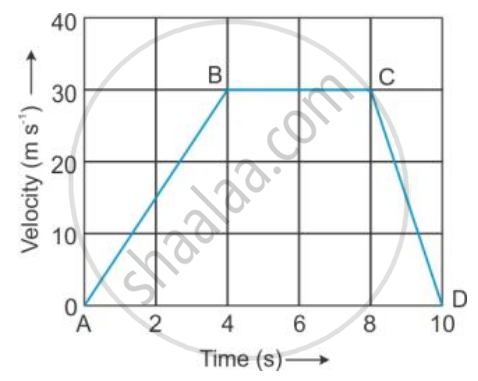
Total displacement.
A speeding car changes its velocity from 108 kmh−1 to 36 kmh−1 in 4 s. Calculate its deceleration in
- ms−2
- kmh−2.
Derive th e equation of motion.
S = ut+ `1/2` at2,
Where the symbols have their usual meanings
