Advertisements
Advertisements
प्रश्न
The distance between Delhi and Agra is 200 km. A train travels the first 100 km at a speed of 50 km/h. How fast must the train travel the next 100 km, so as to average 70 km/h for the whole journey ?
Advertisements
उत्तर
We have the following data to find the speed for the second part of the journey:
Total distance to be travelled by train (D) = 200 km
Average speed required (vavg) = 70 km/hr
Time required for the entire journey (T) :
`"Time" = "Total Distance"/"Average speed"`
= `200/70` hr
T = `20/7` hr
For the first part of the trip:
Distance covered (d1) = 100 km
Speed for this part of journey (v1) = 50 km/hr
Time taken for the first part of journey :
`"Time" = "Distance travelled"/"Speed"`
So,
t1 = `100/50` hr
= 2 hr
For the second part of the trip,
Distance covered (d2) = 100 km
Time taken for the second part of journey :
t2 = T-t1
= `(20/7 - 2)` hr
= `6/7` hr
Speed of the train for the second part of the journey :
= `"distance travelled"/"Time"`
= `((100)(7))/6`
= 116.67 km/hr
APPEARS IN
संबंधित प्रश्न
What does the path of an object look like when it is in uniform motion?
Name the physical quantity obtained by dividing ‘Distance travelled’ by ‘Time taken’ to travel that distance.
What do the following measure in a car ?
(a) Speedometer (b) Odometer
What is the SI unit of retardation ?
A car is moving along a straight road at a steady speed. It travels 150 m in 5 seconds:
What is its average speed ?
Give one example of a motion where an object does not change its speed but its direction of motion changes continuously.
Define average velocity and give one example.
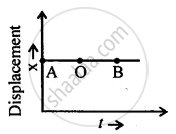
Write down the type of motion of a body along with the A – O – B of the following distance – time graph.
How many variables are present in each equation of motion?
A motorcyclist drives from A to B with a uniform speed of 30 km h–1 and returns back with a speed of 20 km h–1. Find its average speed.
