Advertisements
Advertisements
प्रश्न
The distance between Delhi and Agra is 200 km. A train travels the first 100 km at a speed of 50 km/h. How fast must the train travel the next 100 km, so as to average 70 km/h for the whole journey ?
Advertisements
उत्तर
We have the following data to find the speed for the second part of the journey:
Total distance to be travelled by train (D) = 200 km
Average speed required (vavg) = 70 km/hr
Time required for the entire journey (T) :
`"Time" = "Total Distance"/"Average speed"`
= `200/70` hr
T = `20/7` hr
For the first part of the trip:
Distance covered (d1) = 100 km
Speed for this part of journey (v1) = 50 km/hr
Time taken for the first part of journey :
`"Time" = "Distance travelled"/"Speed"`
So,
t1 = `100/50` hr
= 2 hr
For the second part of the trip,
Distance covered (d2) = 100 km
Time taken for the second part of journey :
t2 = T-t1
= `(20/7 - 2)` hr
= `6/7` hr
Speed of the train for the second part of the journey :
= `"distance travelled"/"Time"`
= `((100)(7))/6`
= 116.67 km/hr
APPEARS IN
संबंधित प्रश्न
During an experiment, a signal from a spaceship reached the ground station in five minutes. What was the distance of the spaceship from the ground station? The signal travels at the speed of light, that is, 3 × 10⁸m s−1.
Abdul, while driving to school, computes the average speed for his trip to be 20 km h−1. On his return trip along the same route, there is less traffic and the average speed is 30 km h−1. What is the average speed for Abdul’s trip?
What is the SI unit of retardation ?
Write the formula for acceleration. Give the meaning of each symbol which occurs in it.
A ball hits a wall horizontally at 6.0 m s-1. It rebounds horizontally at 4.4 m s-1. The ball is in contact with the wall for 0.040 s. What is the acceleration of the ball ?
The tip of seconds’ hand of a dock takes 60 seconds to move once on the circular dial of the clock. If the radius of the dial of the clock be 10.5 cm, calculate the speed of the tip of the seconds’ hand of the clock. `("Given" π= 22/7)`.
The graph given alongside shows how the speed of a car changes with time:
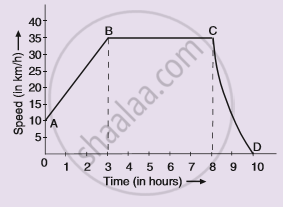
(i) What is the initial speed of the car ?
(ii) What is the maximum speed attained by the car ?
(iii) Which part of the graph shows zero acceleration ?
(iv) Which part of the graph shows varying retardation ?
(v) Find the distance travelled in first 8 hours.
The speed of a car is 72 km h-1. Express it in m s-1.
A train is moving with a velocity of 90 km h-1 . It is brought to stop by applying the brakes which produce a retardation of 0.5 ms-2 Find :
(i) The velocity after 10 s , and
(ii) the time taken by the train to come to rest .
Define speed of a body.
