Advertisements
Advertisements
प्रश्न
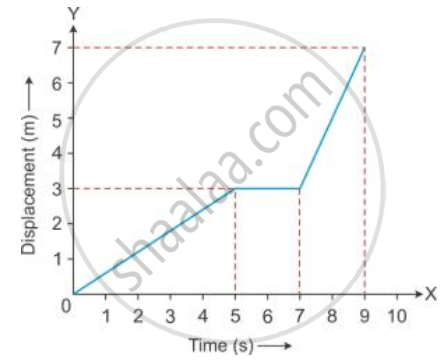
Figure shows the displacement of a body at different times .
Calculate the velocity of the body as it moves for time interval :
(i) 0 to 5 s,
(ii) 5 s to 7 s
(iii) 7 s to 9 s.
Advertisements
उत्तर
(a) (i) Velocity from 0 to 5 s = Displacement /time
= (3/5) m/s
= 0.6 m/s-1
(ii) Velocity from 5 s to 7 s = Displacement /time
= (0/2) m/s
= 0 m/s-1.
(iii) Velocity from 7 s to 9 s = Displacement /time
= (7 - 3)/(9 - 7) m/s
= (4/2) m/s
= 2 m/s-1
APPEARS IN
संबंधित प्रश्न
Joseph jogs from one end A to the other end B of a straight 300 m road in 2 minutes 30 seconds and then turns around and jogs 100 m back to point C in another 1 minute. What are Joseph’s average speeds and velocities in jogging?
- from A to B and
- from A to C?
An aircraft travelling at 600 km/h accelerates steadily at 10 km/h per second. Taking the speed of sound as 1100 km/h at the aircraft’s altitude, how long will it take to reach the ‘sound barrier’ ?
The speed of a moving object is determined to be 0.06 m/s. This speed is equal to :
Which of the following statement is correct regarding velocity and speed of a moving body?
Which of the following can sometimes be 'zero' for a moving body?
(i) average velocity
(ii) distance travelled
(iii) average speed
(iv) displacement
Which of the quantity-velocity or acceleration-determines the direction of motion?
A car moving on a straight path covers a distance of 1 km due east in 100 s. What is the speed of the car?
A car accelerates at a rate of 5 m s-2. Find the increase in its velocity in 2 s.
Figure shows the displacement of a body at different times .
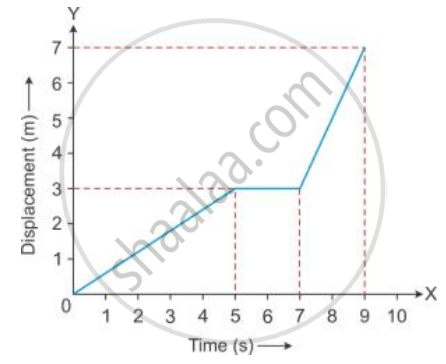
Calculate the average velocity during the time interval 5 s to 9 s ,
[Hint : From 5 s to 9 s , displacement = 7 m - 3m = 4m]
Derive th e equation of motion.
S = ut+ `1/2` at2,
Where the symbols have their usual meanings
