Advertisements
Advertisements
Question
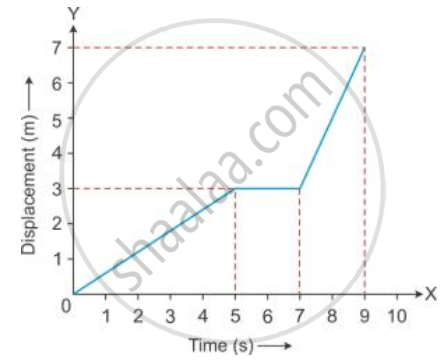
Figure shows the displacement of a body at different times .
Calculate the velocity of the body as it moves for time interval :
(i) 0 to 5 s,
(ii) 5 s to 7 s
(iii) 7 s to 9 s.
Advertisements
Solution
(a) (i) Velocity from 0 to 5 s = Displacement /time
= (3/5) m/s
= 0.6 m/s-1
(ii) Velocity from 5 s to 7 s = Displacement /time
= (0/2) m/s
= 0 m/s-1.
(iii) Velocity from 7 s to 9 s = Displacement /time
= (7 - 3)/(9 - 7) m/s
= (4/2) m/s
= 2 m/s-1
APPEARS IN
RELATED QUESTIONS
Fill in the following blank with suitable word:
The physical quantity which gives both, the speed and direction of motion of a body is called its……………
Write the formula for acceleration. Give the meaning of each symbol which occurs in it.
A motorcyclist starts from rest and reaches a speed of 6 m/s after travelling with uniform acceleration for 3 s. What is his acceleration ?
A car is moving along a straight road at a steady speed. It travels 150 m in 5 seconds:
How far does it travel in 1 second ?
A car is moving along a straight road at a steady speed. It travels 150 m in 5 seconds:
How long does it take to travel 240 m ?
A car travels 100 km at a speed of 60 km/h and returns with a speed of 40 km/h. Calculate the average speed for the whole journey.
Write the formula to calculate the speed of a body moving along a circular path. Give the meaning of each symbol which occurs in it.
What do you mean by motion in one direction?
Give an example of motion in which the average speed is not zero but the average velocity is zero.
How many variables are present in each equation of motion?
