Advertisements
Advertisements
Question
Derive th e equation of motion.
S = ut+ `1/2` at2,
Where the symbols have their usual meanings
Advertisements
Solution
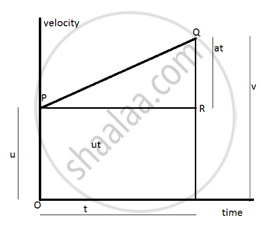
In figure we know
S = area of trapezium OSQP
Area of trapezium OSQP = 1/2 (sum of parallel sides) x perpendicular distance between them.
S = 1/2 (OP + SQ) x PR.
PR= QR/a= (QS-RS) / a
PR= (v - u)/a = t
So PR= t .
Substituting these values in expression of area of trapezium we get
S= 1/2 (u + v) xt
S = 1/2 (u +v) x (u - v)/a.
2aS = v2 - u2
v2 - u2 = 2 as.
This is known as third equation of motion.
APPEARS IN
RELATED QUESTIONS
In addition to speed, what else should we know to predict the position of a moving body ?
State whether speed is a scalar or a vector quantity. Give reason for your choice.
A ball hits a wall horizontally at 6.0 m s-1. It rebounds horizontally at 4.4 m s-1. The ball is in contact with the wall for 0.040 s. What is the acceleration of the ball ?
What do you mean by motion in one direction?
Express the following in m s-1.
18 km min-1
A car travels the first 30 km with a uniform speed of 60 km h−1 and the next 30 km with a uniform speed of 40 km h−1. Calculate :
- The total time of journey,
- The average speed of the car.
The velocity-time graph of a moving body is given below in Figure
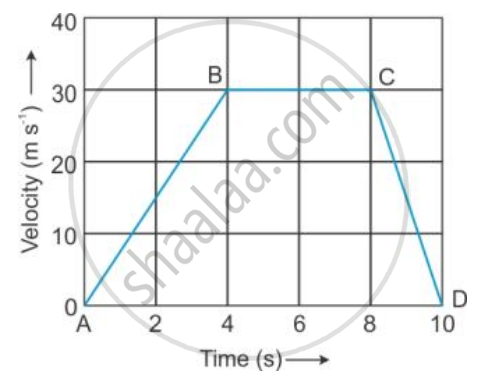
Displacement in each part AB, BC and CD.
A train travels with a speed of 60 km h-1 from station A to station B and then comes back with a speed 80 km h-1 from station B to station A. Find -
- The average speed
- The average velocity of the train.
What are the uses of equations of motion?
A motorcyclist drives from A to B with a uniform speed of 30 km h–1 and returns back with a speed of 20 km h–1. Find its average speed.
