Advertisements
Advertisements
Question
For the motion with uniform velocity , how is the distance travelled related to the time ?
Advertisements
Solution
For the motion with uniform velocity, distance is directly proportional to time.
APPEARS IN
RELATED QUESTIONS
What does the odometer of an automobile measure?
Write the formula for acceleration. Give the meaning of each symbol which occurs in it.
A bus moving along a straight line at 20 m/s undergoes an acceleration of 4 m/s2. After 2 seconds, its speed will be:
When is a body said to be in motion?
Give one example of following motion :
Variable velocity
Express the following in m s-1.
18 km min-1
A car is moving with a velocity 20 m s-1. The brakes are applied to retard it at a rate of 2 m s-2. What will be the velocity after 5 s of applying the brakes?
A train travels with a speed of 60 km h-1 from station A to station B and then comes back with a speed 80 km h-1 from station B to station A. Find -
- The average speed
- The average velocity of the train.
Define variable velocity and give one example.
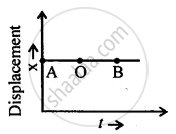
Write down the type of motion of a body along with the A – O – B of the following distance – time graph.