Advertisements
Advertisements
Question
Name the physical quantity obtained by dividing ‘Distance travelled’ by ‘Time taken’ to travel that distance.
Advertisements
Solution
Speed is obtained by dividing 'distance travelled' by 'time taken' to travel that distance.
APPEARS IN
RELATED QUESTIONS
During an experiment, a signal from a spaceship reached the ground station in five minutes. What was the distance of the spaceship from the ground station? The signal travels at the speed of light, that is, 3 × 10⁸m s−1.
If a sprinter runs a distance of 100 metres in 9.83 seconds, calculate his average speed in km/h.
Write the formula to calculate the speed of a body moving along a circular path. Give the meaning of each symbol which occurs in it.
Which of the following can sometimes be 'zero' for a moving body?
(i) average velocity
(ii) distance travelled
(iii) average speed
(iv) displacement
A car travels the first 30 km with a uniform speed of 60 km h−1 and the next 30 km with a uniform speed of 40 km h−1. Calculate :
- The total time of journey,
- The average speed of the car.
A car is moving with a velocity 20 m s-1. The brakes are applied to retard it at a rate of 2 m s-2. What will be the velocity after 5 s of applying the brakes?
From the displacement-time graph of a cyclist given below in the Figure, find The average velocity in the first 4 s.
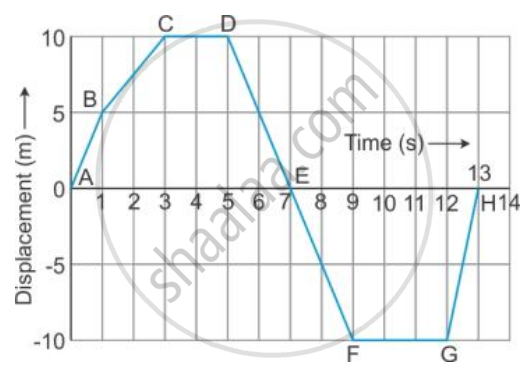
What is the relation between distance and time when the body is moving with variable velocity?
A speeding car changes its velocity from 108 kmh−1 to 36 kmh−1 in 4 s. Calculate its deceleration in
- ms−2
- kmh−2.
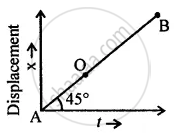
Write down the type of motion of a body along with the A – O – B of the following distance – time graph.