Advertisements
Advertisements
Question
Draw the shape of the velocity-time graph for a body moving with (a) Uniform velocity and (b) Uniform acceleration.
Advertisements
Solution

Velocity-time for a body moving with uniform velocity and uniform acceleration .
APPEARS IN
RELATED QUESTIONS
What does the path of an object look like when it is in uniform motion?
Joseph jogs from one end A to the other end B of a straight 300 m road in 2 minutes 30 seconds and then turns around and jogs 100 m back to point C in another 1 minute. What are Joseph’s average speeds and velocities in jogging?
- from A to B and
- from A to C?
In addition to speed, what else should we know to predict the position of a moving body ?
A train starting from Railway Station attains a speed of 21 m/s in one minute. Find its acceleration.
The graph given alongside shows how the speed of a car changes with time:
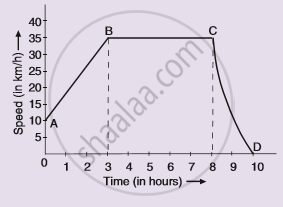
(i) What is the initial speed of the car ?
(ii) What is the maximum speed attained by the car ?
(iii) Which part of the graph shows zero acceleration ?
(iv) Which part of the graph shows varying retardation ?
(v) Find the distance travelled in first 8 hours.
Give one example of following motion :
Uniform velocity
Express the following in m s-1.
18 km min-1
A car travels the first 30 km with a uniform speed of 60 km h−1 and the next 30 km with a uniform speed of 40 km h−1. Calculate :
- The total time of journey,
- The average speed of the car.
A car is moving with a velocity 20 m s-1. The brakes are applied to retard it at a rate of 2 m s-2. What will be the velocity after 5 s of applying the brakes?
A train is moving with a velocity of 90 km h-1 . It is brought to stop by applying the brakes which produce a retardation of 0.5 ms-2 Find :
(i) The velocity after 10 s , and
(ii) the time taken by the train to come to rest .
