Advertisements
Advertisements
Question
A train is moving with a velocity of 90 km h-1 . It is brought to stop by applying the brakes which produce a retardation of 0.5 ms-2 Find :
(i) The velocity after 10 s , and
(ii) the time taken by the train to come to rest .
Advertisements
Solution
Initial velocity u = 90 km/h = 25 m/s
Final velocity v = 0 m/s
Acceleration a = -0.5 m/s2
(i) Let 'V' be the velocity after time t = 10 s
Using the first equation of motion,
v = u + at
We get,
V = 25 + (-0.5) (10) m/s
V = 25 - 5 = 20 m/s-1
(ii) Let t' be the time taken by the train to come to rest.
Using the first equation of motion,
v = u + at
We get,
t' = [(0 - 25)/ (-0.5)] s
t' = 50 s
APPEARS IN
RELATED QUESTIONS
Joseph jogs from one end A to the other end B of a straight 300 m road in 2 minutes 30 seconds and then turns around and jogs 100 m back to point C in another 1 minute. What are Joseph’s average speeds and velocities in jogging?
- from A to B and
- from A to C?
Change the speed of 6 m/s into km/h.
In addition to speed, what else should we know to predict the position of a moving body ?
Arrange the following speed in increasing order (keeping the least speed first):
An athlete running with a speed of 10 m/s.
A car is moving along a straight road at a steady speed. It travels 150 m in 5 seconds:
How far does it travel in 6 seconds ?
A car is moving on a straight road with uniform acceleration. The speed of the car varies with time as follows :
Time (s) : 0 2 4 6 8 10
Speed (m/s) : 4 8 12 16 20 24
Draw the speed-time graph by choosing a convenient scale. From this graph :
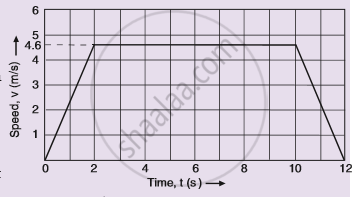
(1) Calculate the acceleration of the car.
(2) Calculate the distance travelled by the car in 10 seconds.
Which of the quantity-velocity or acceleration-determines the direction of motion?
A car travels the first 30 km with a uniform speed of 60 km h−1 and the next 30 km with a uniform speed of 40 km h−1. Calculate :
- The total time of journey,
- The average speed of the car.
The velocity-time graph of a moving body is given below in Figure
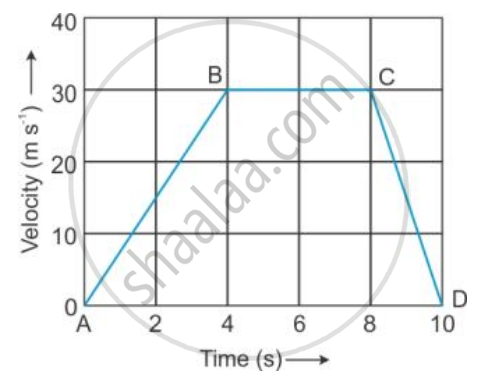
Displacement in each part AB, BC and CD.
What is the relation between distance and time when the body is moving with variable velocity?
