Advertisements
Advertisements
Question
A train travels with a speed of 60 km h-1 from station A to station B and then comes back with a speed 80 km h-1 from station B to station A. Find -
- The average speed
- The average velocity of the train.
Advertisements
Solution
(i) Given,
From, A to B
speedAB = 60 km h-1
distance travelled = dAB = d
time taken = `"d"/60`
From, B to A
speedBA = 80 km h-1
distance travelled = dBA = d
time taken = `"d"/80`
Total distance travelled = d + d = 2d ...[Eqn. 1]
Total time = `"d"/60 + "d"/80` ...[Eqn. 2]
Substituting the values from the equations 1 and 2 in the formula we get,
Average speed = `"Total Distance"/"Total time"`
= `"2d"/("d"/60 + "d"/80)`
= `"2d"/(("4d" + "3d")/240)`
= `("2d"/"7d")/240`
= `(2/7)/240`
= `(2 xx 240)/7`
= `480/7`
= 68.57 km h-1
Hence, Average Speed = 68.57 km h-1
(ii) Average velocity = `"Displacement"/"total time taken"`
Because the train starts and ends at the same station, the displacement is zero. Thus the average velocity is zero.
APPEARS IN
RELATED QUESTIONS
During an experiment, a signal from a spaceship reached the ground station in five minutes. What was the distance of the spaceship from the ground station? The signal travels at the speed of light, that is, 3 × 10⁸m s−1.
Joseph jogs from one end A to the other end B of a straight 300 m road in 2 minutes 30 seconds and then turns around and jogs 100 m back to point C in another 1 minute. What are Joseph’s average speeds and velocities in jogging?
- from A to B and
- from A to C?
Bus X travels a distance of 360 km in 5 hours whereas bus Y travels a distance of 476 km in 7 hours. Which
bus travels faster ?
Convert a speed of 54 km/h into m/s.
A car is moving along a straight road at a steady speed. It travels 150 m in 5 seconds:
What is its average speed ?
A car travels 100 km at a speed of 60 km/h and returns with a speed of 40 km/h. Calculate the average speed for the whole journey.
Express the following in m s−1.
1 km h−1
The velocity-time graph of a moving body is given below in Figure
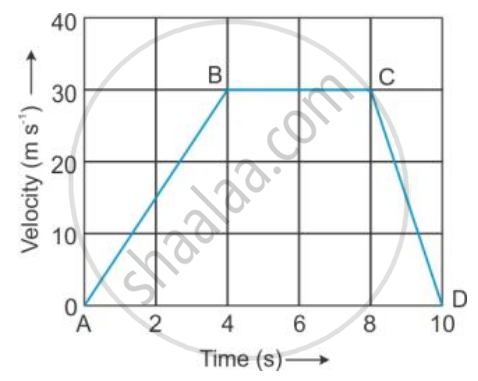
Total displacement.
Define average velocity and give one example.
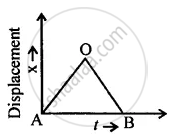
Write down the type of motion of a body along with the A – O – B of the following distance – time graph.