Advertisements
Advertisements
प्रश्न
A train travels with a speed of 60 km h-1 from station A to station B and then comes back with a speed 80 km h-1 from station B to station A. Find -
- The average speed
- The average velocity of the train.
Advertisements
उत्तर
(i) Given,
From, A to B
speedAB = 60 km h-1
distance travelled = dAB = d
time taken = `"d"/60`
From, B to A
speedBA = 80 km h-1
distance travelled = dBA = d
time taken = `"d"/80`
Total distance travelled = d + d = 2d ...[Eqn. 1]
Total time = `"d"/60 + "d"/80` ...[Eqn. 2]
Substituting the values from the equations 1 and 2 in the formula we get,
Average speed = `"Total Distance"/"Total time"`
= `"2d"/("d"/60 + "d"/80)`
= `"2d"/(("4d" + "3d")/240)`
= `("2d"/"7d")/240`
= `(2/7)/240`
= `(2 xx 240)/7`
= `480/7`
= 68.57 km h-1
Hence, Average Speed = 68.57 km h-1
(ii) Average velocity = `"Displacement"/"total time taken"`
Because the train starts and ends at the same station, the displacement is zero. Thus the average velocity is zero.
APPEARS IN
संबंधित प्रश्न
Joseph jogs from one end A to the other end B of a straight 300 m road in 2 minutes 30 seconds and then turns around and jogs 100 m back to point C in another 1 minute. What are Joseph’s average speeds and velocities in jogging?
- from A to B and
- from A to C?
The distance between Delhi and Agra is 200 km. A train travels the first 100 km at a speed of 50 km/h. How fast must the train travel the next 100 km, so as to average 70 km/h for the whole journey ?
A car is moving along a straight road at a steady speed. It travels 150 m in 5 seconds:
How far does it travel in 6 seconds ?
The graph given alongside shows how the speed of a car changes with time:
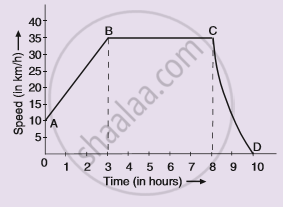
(i) What is the initial speed of the car ?
(ii) What is the maximum speed attained by the car ?
(iii) Which part of the graph shows zero acceleration ?
(iv) Which part of the graph shows varying retardation ?
(v) Find the distance travelled in first 8 hours.
The speed of a moving object is determined to be 0.06 m/s. This speed is equal to :
Which of the following can sometimes be 'zero' for a moving body?
(i) average velocity
(ii) distance travelled
(iii) average speed
(iv) displacement
One of the following is not a vector quantity. This one is :
When is a body said to be in motion?
Give one example of following motion :
Uniform velocity
Define average velocity and give one example.
