Advertisements
Advertisements
प्रश्न
A train is moving with a velocity of 90 km h-1 . It is brought to stop by applying the brakes which produce a retardation of 0.5 ms-2 Find :
(i) The velocity after 10 s , and
(ii) the time taken by the train to come to rest .
Advertisements
उत्तर
Initial velocity u = 90 km/h = 25 m/s
Final velocity v = 0 m/s
Acceleration a = -0.5 m/s2
(i) Let 'V' be the velocity after time t = 10 s
Using the first equation of motion,
v = u + at
We get,
V = 25 + (-0.5) (10) m/s
V = 25 - 5 = 20 m/s-1
(ii) Let t' be the time taken by the train to come to rest.
Using the first equation of motion,
v = u + at
We get,
t' = [(0 - 25)/ (-0.5)] s
t' = 50 s
APPEARS IN
संबंधित प्रश्न
Abdul, while driving to school, computes the average speed for his trip to be 20 km h−1. On his return trip along the same route, there is less traffic and the average speed is 30 km h−1. What is the average speed for Abdul’s trip?
A motorcyclist starts from rest and reaches a speed of 6 m/s after travelling with uniform acceleration for 3 s. What is his acceleration ?
If a bus travelling at 20 m/s is subjected to a steady deceleration of 5 m/s2, how long will it take to come to rest ?
A car travels 100 km at a speed of 60 km/h and returns with a speed of 40 km/h. Calculate the average speed for the whole journey.
A car is moving on a straight road with uniform acceleration. The speed of the car varies with time as follows :
Time (s) : 0 2 4 6 8 10
Speed (m/s) : 4 8 12 16 20 24
Draw the speed-time graph by choosing a convenient scale. From this graph :
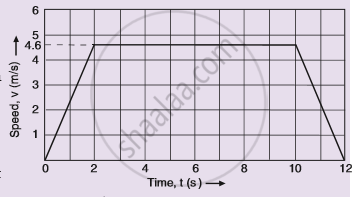
(1) Calculate the acceleration of the car.
(2) Calculate the distance travelled by the car in 10 seconds.
A car moving on a straight path covers a distance of 1 km due east in 100 s. What is the speed of the car?
Define average velocity and give one example.
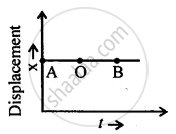
Write down the type of motion of a body along with the A – O – B of the following distance – time graph.
Distinguish between speed and velocity.
