Advertisements
Advertisements
Question
If a bus travelling at 20 m/s is subjected to a steady deceleration of 5 m/s2, how long will it take to come to rest ?
Advertisements
Solution
We have to find the time taken to reach the given final velocity.
We have:
Initial velocity (u) = 20 m/s
Final velocity (v) = 0 m/s
Acceleration for the entire journey (a) = –5 ms2.
Let the time taken be (t).
We can calculate the time taken using the first equation of motion.
`t = (v-u)/a`
Time taken by the bus to come to rest:
= `(0-20)/-5`
= 4 s
APPEARS IN
RELATED QUESTIONS
What does the odometer of an automobile measure?
Write the formula for acceleration. Give the meaning of each symbol which occurs in it.
A train starting from Railway Station attains a speed of 21 m/s in one minute. Find its acceleration.
A car is moving along a straight road at a steady speed. It travels 150 m in 5 seconds:
How far does it travel in 1 second ?
The tip of seconds’ hand of a dock takes 60 seconds to move once on the circular dial of the clock. If the radius of the dial of the clock be 10.5 cm, calculate the speed of the tip of the seconds’ hand of the clock. `("Given" π= 22/7)`.
A car is moving with a velocity 20 m s-1. The brakes are applied to retard it at a rate of 2 m s-2. What will be the velocity after 5 s of applying the brakes?
Figure shows the displacement of a body at different times .
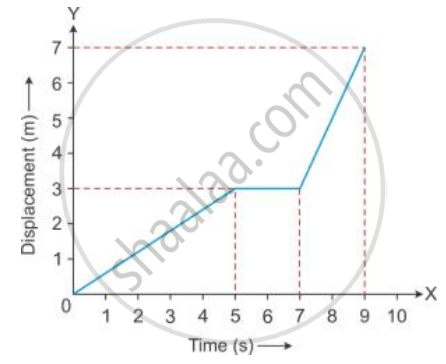
Calculate the average velocity during the time interval 5 s to 9 s ,
[Hint : From 5 s to 9 s , displacement = 7 m - 3m = 4m]
Draw a diagram to show the motion of a body whose speed remains constant, but velocity changes continuously.
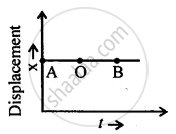
Write down the type of motion of a body along with the A – O – B of the following distance – time graph.