Advertisements
Advertisements
Question
An aircraft travelling at 600 km/h accelerates steadily at 10 km/h per second. Taking the speed of sound as 1100 km/h at the aircraft’s altitude, how long will it take to reach the ‘sound barrier’ ?
Advertisements
Solution
Final velocity, v = 1100 km/h = 1100 × 5/18 = 305.55 m/s
Initial velocity, u = 600 km/h = 600 × 5/18 = 166.66 m/s
Acceleration = 10 km/h per second = 10 × 5/18 = 2.77 m/s2
Time taken by body,
v = u + at
t = (v - u)/a
t = (305.55 -166.66 )/2.77
t = 50.14 sec
t ≃ 50 sec
APPEARS IN
RELATED QUESTIONS
What do the following measure in a car ?
(a) Speedometer (b) Odometer
A car is moving along a straight road at a steady speed. It travels 150 m in 5 seconds:
How far does it travel in 1 second ?
A car is moving along a straight road at a steady speed. It travels 150 m in 5 seconds:
How far does it travel in 6 seconds ?
A train starting from rest moves with a uniform acceleration of 0.2 m/s2 for 5 minutes. Calculate the speed acquired and the distance travelled in this time.
Give an example of the motion of a body moving with a constant speed but with a variable velocity. Draw a diagram to represent such a motion.
A train takes 2 h to reach station B from station A, and then 3 h to return from station B to station A. The distance between the two stations is 200 km. Find:
The average speed,
The average velocity of the train.
A car moving on a straight path covers a distance of 1 km due east in 100 s. What is the speed of the car?
The velocity-time graph of a moving body is given below in Figure
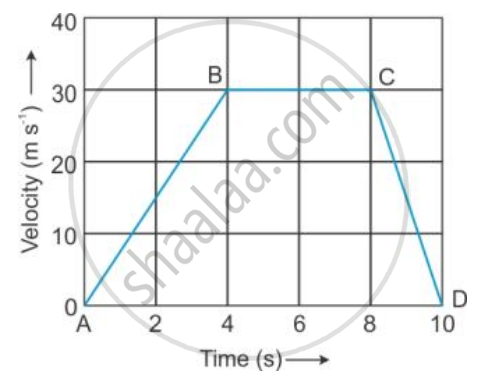
Displacement in each part AB, BC and CD.
What is the relation between distance and time when the body is moving with uniform velocity?
A body projected vertically up with a velocity of 10 m/s reaches a height of 20 m. If it is projected with a velocity of 20 m/s, then the maximum height reached by the body is:
