Advertisements
Advertisements
प्रश्न
An aircraft travelling at 600 km/h accelerates steadily at 10 km/h per second. Taking the speed of sound as 1100 km/h at the aircraft’s altitude, how long will it take to reach the ‘sound barrier’ ?
Advertisements
उत्तर
Final velocity, v = 1100 km/h = 1100 × 5/18 = 305.55 m/s
Initial velocity, u = 600 km/h = 600 × 5/18 = 166.66 m/s
Acceleration = 10 km/h per second = 10 × 5/18 = 2.77 m/s2
Time taken by body,
v = u + at
t = (v - u)/a
t = (305.55 -166.66 )/2.77
t = 50.14 sec
t ≃ 50 sec
APPEARS IN
संबंधित प्रश्न
A motorcyclist drives from place A to B with a uniform speed of 30 km h-1 and returns from place B to A with a uniform speed of 20 km h-1. Find his average speed.
A car is moving along a straight road at a steady speed. It travels 150 m in 5 seconds:
How far does it travel in 1 second ?
A ball hits a wall horizontally at 6.0 m s-1. It rebounds horizontally at 4.4 m s-1. The ball is in contact with the wall for 0.040 s. What is the acceleration of the ball ?
The graph given alongside shows how the speed of a car changes with time:
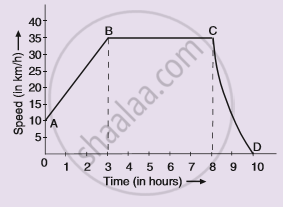
(i) What is the initial speed of the car ?
(ii) What is the maximum speed attained by the car ?
(iii) Which part of the graph shows zero acceleration ?
(iv) Which part of the graph shows varying retardation ?
(v) Find the distance travelled in first 8 hours.
Give an example of the motion of a body moving with a constant speed but with a variable velocity. Draw a diagram to represent such a motion.
For the motion with uniform velocity , how is the distance travelled related to the time ?
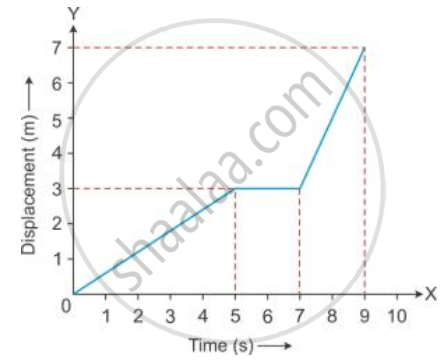
Figure shows the displacement of a body at different times .
Calculate the velocity of the body as it moves for time interval :
(i) 0 to 5 s,
(ii) 5 s to 7 s
(iii) 7 s to 9 s.
A body moves from rest with uniform acceleration and travels 270 m in 3 s. Find the velocity of the body at 10 s after the start.
Define average velocity and give one example.
