Advertisements
Advertisements
प्रश्न
If a bus travelling at 20 m/s is subjected to a steady deceleration of 5 m/s2, how long will it take to come to rest ?
Advertisements
उत्तर
We have to find the time taken to reach the given final velocity.
We have:
Initial velocity (u) = 20 m/s
Final velocity (v) = 0 m/s
Acceleration for the entire journey (a) = –5 ms2.
Let the time taken be (t).
We can calculate the time taken using the first equation of motion.
`t = (v-u)/a`
Time taken by the bus to come to rest:
= `(0-20)/-5`
= 4 s
APPEARS IN
संबंधित प्रश्न
Bus X travels a distance of 360 km in 5 hours whereas bus Y travels a distance of 476 km in 7 hours. Which
bus travels faster ?
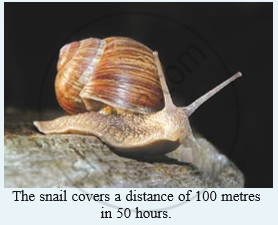
A snail covers a distance of 100 metres in 50 hours. Calculate the average speed of snail in km/h.
A ball hits a wall horizontally at 6.0 m s-1. It rebounds horizontally at 4.4 m s-1. The ball is in contact with the wall for 0.040 s. What is the acceleration of the ball ?
One of the following is not a vector quantity. This one is :
A bus moving along a straight line at 20 m/s undergoes an acceleration of 4 m/s2. After 2 seconds, its speed will be:
A car is moving in a straight line with speed 18 km h-1. It is stopped in 5 s by applying the brakes. Find:
- the speed of car in m s-1
- the retardation and
- the speed of car after 2 s of applying the brakes.
Define variable velocity and give one example.
What is the relation between distance and time when the body is moving with uniform velocity?
A speeding car changes its velocity from 108 kmh−1 to 36 kmh−1 in 4 s. Calculate its deceleration in
- ms−2
- kmh−2.
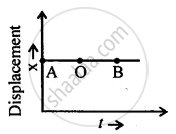
Write down the type of motion of a body along with the A – O – B of the following distance – time graph.