Advertisements
Advertisements
प्रश्न
Arrange the following speeds in increasing order.
10 m s-1, 1 km min-1 and 18 km h-1.
Advertisements
उत्तर
18 km h-1 < 10 m s-1 < 1 km min-1
APPEARS IN
संबंधित प्रश्न
What does the path of an object look like when it is in uniform motion?
Bus X travels a distance of 360 km in 5 hours whereas bus Y travels a distance of 476 km in 7 hours. Which
bus travels faster ?
Arrange the following speed in increasing order (keeping the least speed first):
An athlete running with a speed of 10 m/s.
If a sprinter runs a distance of 100 metres in 9.83 seconds, calculate his average speed in km/h.
A motorcyclist starts from rest and reaches a speed of 6 m/s after travelling with uniform acceleration for 3 s. What is his acceleration ?
The tip of seconds’ hand of a dock takes 60 seconds to move once on the circular dial of the clock. If the radius of the dial of the clock be 10.5 cm, calculate the speed of the tip of the seconds’ hand of the clock. `("Given" π= 22/7)`.
The velocity-time graph of a moving body is given below in Figure
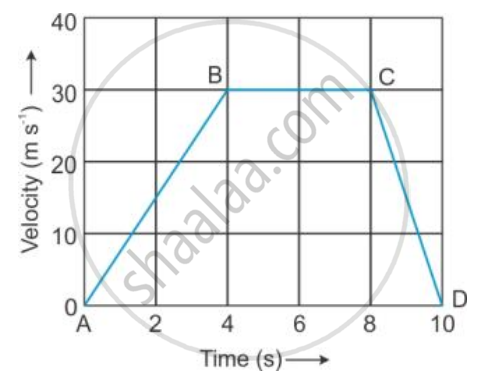
The acceleration in parts AB, BC and CD.
Define average velocity and give one example.
A body projected vertically up with a velocity of 10 m/s reaches a height of 20 m. If it is projected with a velocity of 20 m/s, then the maximum height reached by the body is:
Give two examples of uniform circular motion from your daily life.
