Advertisements
Advertisements
प्रश्न
A body projected vertically up with a velocity of 10 m/s reaches a height of 20 m. If it is projected with a velocity of 20 m/s, then the maximum height reached by the body is:
विकल्प
20 m
10 m
80 m
40 m
Advertisements
उत्तर
80 m
Explanation:
Initial velocity = u = 10 m/s
Height = Distance = S = 20 m
At highest point, Final velocity = v = 0
Acceleration = (a) = ?
Case − I
v2 − u2 = 2aS
(0)2 − (10)2 = 2a (20)
a = `-100/40` = −2.5 ms−2
Case – II
u = 20 m/s; v = 0
a = −2.5 ms−2; S = h /
v2 − u2 = 2aS
(0)2 − (20)2 = 2(−2.5)h
h = `400/5` = 80 m
APPEARS IN
संबंधित प्रश्न
What does the path of an object look like when it is in uniform motion?
Abdul, while driving to school, computes the average speed for his trip to be 20 km h−1. On his return trip along the same route, there is less traffic and the average speed is 30 km h−1. What is the average speed for Abdul’s trip?
A train travels the first 15 km at a uniform speed of 30 km/h; the next 75 km at a uniform speed of 50 km/h; and the last 10 km at a uniform speed of 20 km/h. Calculate the average speed for the entire train journey.
A car is moving along a straight road at a steady speed. It travels 150 m in 5 seconds:
What is its average speed ?
The graph given alongside shows how the speed of a car changes with time:
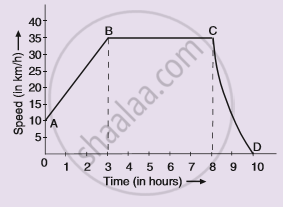
(i) What is the initial speed of the car ?
(ii) What is the maximum speed attained by the car ?
(iii) Which part of the graph shows zero acceleration ?
(iv) Which part of the graph shows varying retardation ?
(v) Find the distance travelled in first 8 hours.
A train takes 2 h to reach station B from station A, and then 3 h to return from station B to station A. The distance between the two stations is 200 km. Find:
The average speed,
The average velocity of the train.
The velocity-time graph of a moving body is given below in Figure
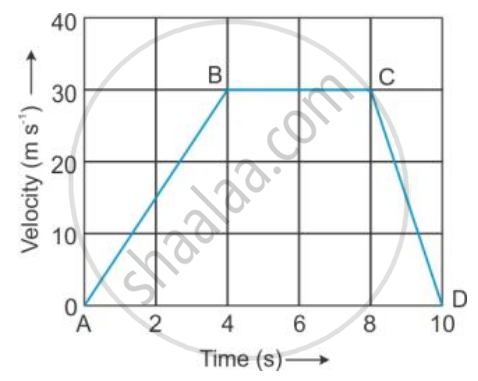
Total displacement.
The velocity-time graph of a moving body is given below in Figure
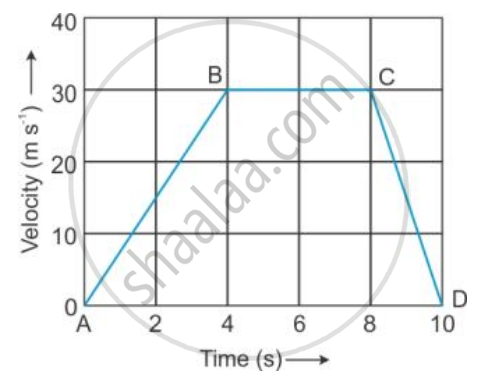
Displacement in each part AB, BC and CD.
The velocity-time graph of a moving body is given below in Figure
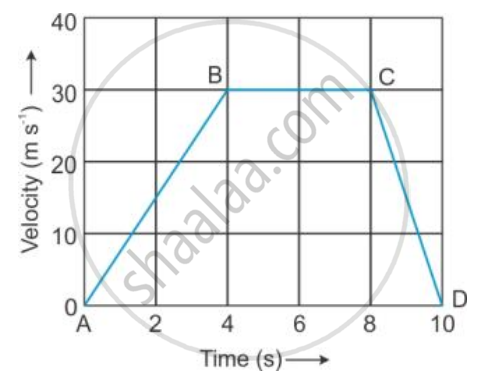
The acceleration in parts AB, BC and CD.
Define speed of a body.
