Advertisements
Advertisements
प्रश्न
A body moves from rest with uniform acceleration and travels 270 m in 3 s. Find the velocity of the body at 10 s after the start.
Advertisements
उत्तर
Initial velocity u = 0 m/s
Distance travelled s = 270 m
Time taken to travel s distance = 3 s
Let 'a' be the uniform acceleration.
Using the second equation of motion,
S = ut + (1/2) at2
We get,
270 = 0 + (1/2) a (3)2
270 = 9a/2
a = 60 m/s2
Let v be the velocity of the body 10 s after the start.
Using the first equation of motion, we get
v = u + at
v = 0 + (60)(10) = 600 m/s-1
APPEARS IN
संबंधित प्रश्न
Joseph jogs from one end A to the other end B of a straight 300 m road in 2 minutes 30 seconds and then turns around and jogs 100 m back to point C in another 1 minute. What are Joseph’s average speeds and velocities in jogging?
- from A to B and
- from A to C?
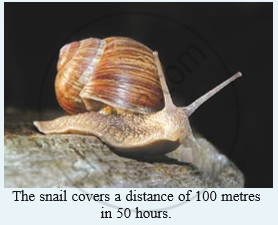
A snail covers a distance of 100 metres in 50 hours. Calculate the average speed of snail in km/h.
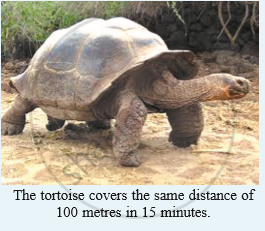
A tortoise moves a distance of 100 metres in 15 minutes. What is the average speed of tortoise in km/h ?
A car is moving along a straight road at a steady speed. It travels 150 m in 5 seconds:
How long does it take to travel 240 m ?
A train starting from rest moves with a uniform acceleration of 0.2 m/s2 for 5 minutes. Calculate the speed acquired and the distance travelled in this time.
A bus moving along a straight line at 20 m/s undergoes an acceleration of 4 m/s2. After 2 seconds, its speed will be:
Give one example of following motion :
Variable velocity
From the displacement-time graph of a cyclist given below in the Figure, find The average velocity in the first 4 s.
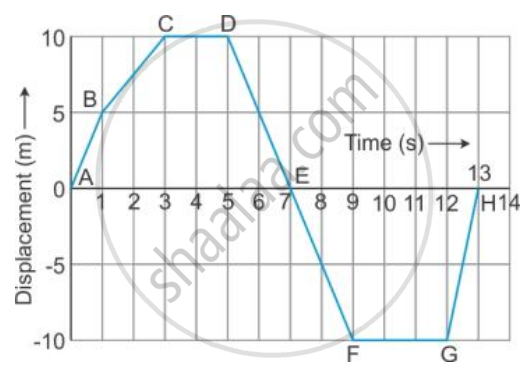
What is the relation between distance and time when the body is moving with variable velocity?
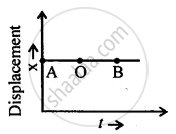
Write down the type of motion of a body along with the A – O – B of the following distance – time graph.