Advertisements
Advertisements
प्रश्न
A body projected vertically up with a velocity of 10 m/s reaches a height of 20 m. If it is projected with a velocity of 20 m/s, then the maximum height reached by the body is:
पर्याय
20 m
10 m
80 m
40 m
Advertisements
उत्तर
80 m
Explanation:
Initial velocity = u = 10 m/s
Height = Distance = S = 20 m
At highest point, Final velocity = v = 0
Acceleration = (a) = ?
Case − I
v2 − u2 = 2aS
(0)2 − (10)2 = 2a (20)
a = `-100/40` = −2.5 ms−2
Case – II
u = 20 m/s; v = 0
a = −2.5 ms−2; S = h /
v2 − u2 = 2aS
(0)2 − (20)2 = 2(−2.5)h
h = `400/5` = 80 m
APPEARS IN
संबंधित प्रश्न
What does the path of an object look like when it is in uniform motion?
What do the following measure in a car ?
(a) Speedometer (b) Odometer
State whether speed is a scalar or a vector quantity. Give reason for your choice.
If a bus travelling at 20 m/s is subjected to a steady deceleration of 5 m/s2, how long will it take to come to rest ?
The tip of seconds’ hand of a dock takes 60 seconds to move once on the circular dial of the clock. If the radius of the dial of the clock be 10.5 cm, calculate the speed of the tip of the seconds’ hand of the clock. `("Given" π= 22/7)`.
A bus moving along a straight line at 20 m/s undergoes an acceleration of 4 m/s2. After 2 seconds, its speed will be:
When is a body said to be in motion?
A train travels with a speed of 60 km h-1 from station A to station B and then comes back with a speed 80 km h-1 from station B to station A. Find -
- The average speed
- The average velocity of the train.
Define average velocity and give one example.
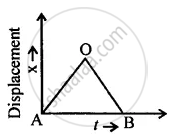
Write down the type of motion of a body along with the A – O – B of the following distance – time graph.