Advertisements
Advertisements
प्रश्न
Derive th e equation of motion.
S = ut+ `1/2` at2,
Where the symbols have their usual meanings
Advertisements
उत्तर
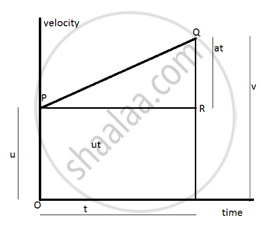
In figure we know
S = area of trapezium OSQP
Area of trapezium OSQP = 1/2 (sum of parallel sides) x perpendicular distance between them.
S = 1/2 (OP + SQ) x PR.
PR= QR/a= (QS-RS) / a
PR= (v - u)/a = t
So PR= t .
Substituting these values in expression of area of trapezium we get
S= 1/2 (u + v) xt
S = 1/2 (u +v) x (u - v)/a.
2aS = v2 - u2
v2 - u2 = 2 as.
This is known as third equation of motion.
APPEARS IN
संबंधित प्रश्न
What is the Differnece between speed and velocity ?
Abdul, while driving to school, computes the average speed for his trip to be 20 km h−1. On his return trip along the same route, there is less traffic and the average speed is 30 km h−1. What is the average speed for Abdul’s trip?
Bus X travels a distance of 360 km in 5 hours whereas bus Y travels a distance of 476 km in 7 hours. Which
bus travels faster ?
If a bus travelling at 20 m/s is subjected to a steady deceleration of 5 m/s2, how long will it take to come to rest ?
The graph given alongside shows how the speed of a car changes with time:
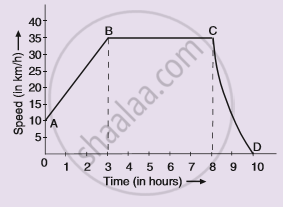
(i) What is the initial speed of the car ?
(ii) What is the maximum speed attained by the car ?
(iii) Which part of the graph shows zero acceleration ?
(iv) Which part of the graph shows varying retardation ?
(v) Find the distance travelled in first 8 hours.
One of the following is not a vector quantity. This one is :
Give an example of motion in which the average speed is not zero but the average velocity is zero.
Give one example of following motion :
Uniform velocity
Define variable velocity and give one example.
What are the uses of equations of motion?
