Advertisements
Advertisements
प्रश्न
Derive th e equation of motion.
S = ut+ `1/2` at2,
Where the symbols have their usual meanings
Advertisements
उत्तर
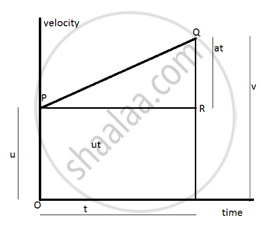
In figure we know
S = area of trapezium OSQP
Area of trapezium OSQP = 1/2 (sum of parallel sides) x perpendicular distance between them.
S = 1/2 (OP + SQ) x PR.
PR= QR/a= (QS-RS) / a
PR= (v - u)/a = t
So PR= t .
Substituting these values in expression of area of trapezium we get
S= 1/2 (u + v) xt
S = 1/2 (u +v) x (u - v)/a.
2aS = v2 - u2
v2 - u2 = 2 as.
This is known as third equation of motion.
APPEARS IN
संबंधित प्रश्न
What does the odometer of an automobile measure?
Change the speed of 6 m/s into km/h.
The distance between Delhi and Agra is 200 km. A train travels the first 100 km at a speed of 50 km/h. How fast must the train travel the next 100 km, so as to average 70 km/h for the whole journey ?
A car is moving along a straight road at a steady speed. It travels 150 m in 5 seconds:
What is its average speed ?
The speed of a moving object is determined to be 0.06 m/s. This speed is equal to :
Which of the following can sometimes be 'zero' for a moving body?
(i) average velocity
(ii) distance travelled
(iii) average speed
(iv) displacement
Which of the following could not be a unit of speed?
A train travels with a speed of 60 km h-1 from station A to station B and then comes back with a speed 80 km h-1 from station B to station A. Find -
- The average speed
- The average velocity of the train.
What is the relation between distance and time when the body is moving with uniform velocity?
Define speed of a body.
