Advertisements
Advertisements
प्रश्न
A ball hits a wall horizontally at 6.0 m s-1. It rebounds horizontally at 4.4 m s-1. The ball is in contact with the wall for 0.040 s. What is the acceleration of the ball ?
Advertisements
उत्तर
We have to find the value of uniform acceleration.
We have:
Initial velocity (u) = 6 m/s
Final velocity is in opposite direction to that of initial velocity (v) = –4.4 m/s
Time taken (t) = 0.04 s
Acceleration :
`a = "υ-u"/t`
Put the values in the above equation to get the value of acceleration .
`a = "-4.4-6"/0.04`
= `10.4/0.04`
= `-260 "m/s"^2`
APPEARS IN
संबंधित प्रश्न
What is the Differnece between speed and velocity ?
Name the physical quantity obtained by dividing ‘Distance travelled’ by ‘Time taken’ to travel that distance.
Under which condition is the magnitude of average velocity equal to average speed ?
A car is moving along a straight road at a steady speed. It travels 150 m in 5 seconds:
How far does it travel in 6 seconds ?
Give one example of following motion :
Uniform velocity
A train takes 2 h to reach station B from station A, and then 3 h to return from station B to station A. The distance between the two stations is 200 km. Find:
The average speed,
The average velocity of the train.
A car accelerates at a rate of 5 m s-2. Find the increase in its velocity in 2 s.
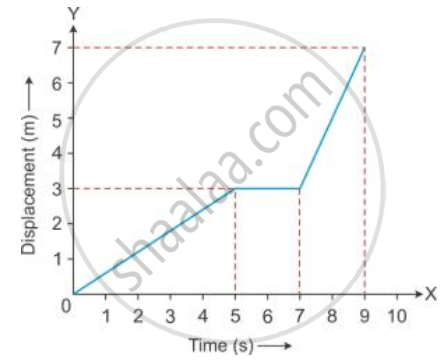
Figure shows the displacement of a body at different times .
Calculate the velocity of the body as it moves for time interval :
(i) 0 to 5 s,
(ii) 5 s to 7 s
(iii) 7 s to 9 s.
The velocity-time graph of a moving body is given below in Figure
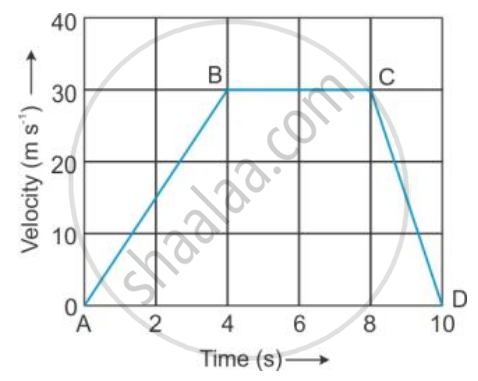
Total displacement.
A speeding car changes its velocity from 108 kmh−1 to 36 kmh−1 in 4 s. Calculate its deceleration in
- ms−2
- kmh−2.
