Advertisements
Advertisements
प्रश्न
A car travels 100 km at a speed of 60 km/h and returns with a speed of 40 km/h. Calculate the average speed for the whole journey.
Advertisements
उत्तर
In the first case, the car travels at a speed of 60 km/h for a distance of 100 km.
Thus,
`"Time" = "Distance travelled"/"Speed"`
So , t1 = `100/60` hr
= `5/3` hr
In the second case, the car travels at a speed of 40 km/h for a distance of 100 km.
Thus,
`"Time" = "Distance travelled"/"Speed"`
So , t2 = `100/40` hr
= `5/2` hr
Total time taken :
= t1 + t2
= `5/3 + 5/2` hr
= `25/6` hr
Total distance travelled = 200 km
We can calculate average speed as:
`"Average Speed" = "Tatal Distance travelled"/"Time"`
Average speed for the entire journey :
= `"(200)(6)"/25`
= 48 km/hr
APPEARS IN
संबंधित प्रश्न
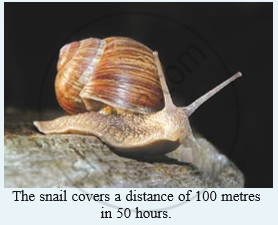
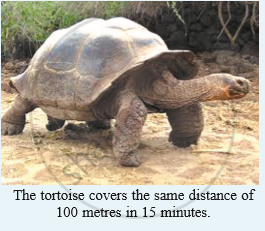
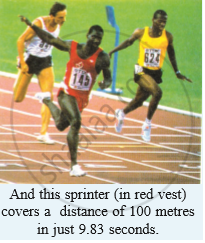
A snail covers a distance of 100 metres in 50 hours. Calculate the average speed of snail in km/h.
Which of the following could not be a unit of speed?
One of the following is not a vector quantity. This one is :
When is a body said to be in motion?
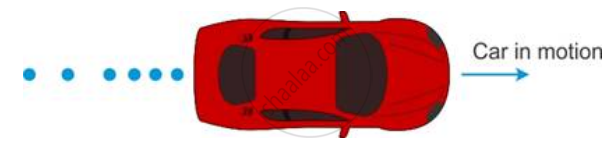
The diagram below shows the pattern of the oil on the road at a constant rate from a moving car. What information do you get from it about the motion of the car.
Arrange the following speeds in increasing order.
10 m s-1, 1 km min-1 and 18 km h-1.
The velocity-time graph of a moving body is given below in Figure
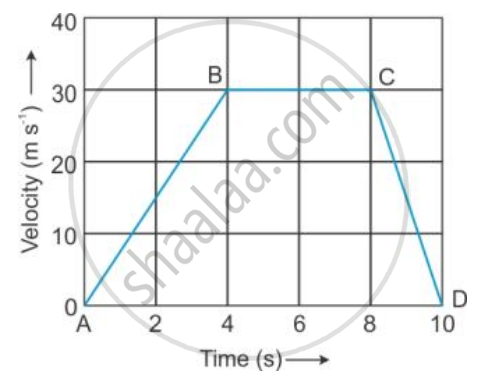
Displacement in each part AB, BC and CD.
Define average velocity and give one example.
Define uniform velocity and give one example.
What are the uses of equations of motion?
