Advertisements
Advertisements
Question
A car travels 100 km at a speed of 60 km/h and returns with a speed of 40 km/h. Calculate the average speed for the whole journey.
Advertisements
Solution
In the first case, the car travels at a speed of 60 km/h for a distance of 100 km.
Thus,
`"Time" = "Distance travelled"/"Speed"`
So , t1 = `100/60` hr
= `5/3` hr
In the second case, the car travels at a speed of 40 km/h for a distance of 100 km.
Thus,
`"Time" = "Distance travelled"/"Speed"`
So , t2 = `100/40` hr
= `5/2` hr
Total time taken :
= t1 + t2
= `5/3 + 5/2` hr
= `25/6` hr
Total distance travelled = 200 km
We can calculate average speed as:
`"Average Speed" = "Tatal Distance travelled"/"Time"`
Average speed for the entire journey :
= `"(200)(6)"/25`
= 48 km/hr
APPEARS IN
RELATED QUESTIONS
The distance between Delhi and Agra is 200 km. A train travels the first 100 km at a speed of 50 km/h. How fast must the train travel the next 100 km, so as to average 70 km/h for the whole journey ?
A train travels the first 15 km at a uniform speed of 30 km/h; the next 75 km at a uniform speed of 50 km/h; and the last 10 km at a uniform speed of 20 km/h. Calculate the average speed for the entire train journey.
The speed of a moving object is determined to be 0.06 m/s. This speed is equal to :
A bus moving along a straight line at 20 m/s undergoes an acceleration of 4 m/s2. After 2 seconds, its speed will be:
When is a body said to be in motion?
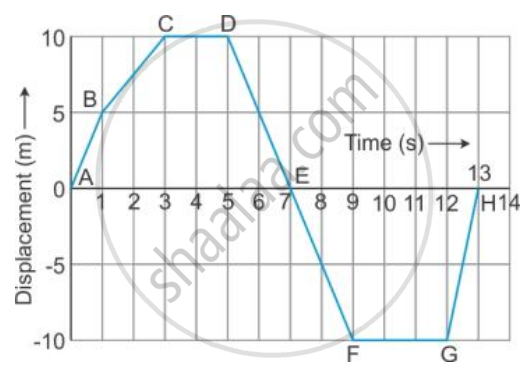
From the displacement-time graph of a cyclist given below in the Figure, find The average velocity in the first 4 s.
A body moves from rest with uniform acceleration and travels 270 m in 3 s. Find the velocity of the body at 10 s after the start.
What is the relation between distance and time when the body is moving with variable velocity?
Derive th e equation of motion.
S = ut+ `1/2` at2,
Where the symbols have their usual meanings
A motorcyclist drives from A to B with a uniform speed of 30 km h–1 and returns back with a speed of 20 km h–1. Find its average speed.
