Advertisements
Advertisements
प्रश्न
A car travels 100 km at a speed of 60 km/h and returns with a speed of 40 km/h. Calculate the average speed for the whole journey.
Advertisements
उत्तर
In the first case, the car travels at a speed of 60 km/h for a distance of 100 km.
Thus,
`"Time" = "Distance travelled"/"Speed"`
So , t1 = `100/60` hr
= `5/3` hr
In the second case, the car travels at a speed of 40 km/h for a distance of 100 km.
Thus,
`"Time" = "Distance travelled"/"Speed"`
So , t2 = `100/40` hr
= `5/2` hr
Total time taken :
= t1 + t2
= `5/3 + 5/2` hr
= `25/6` hr
Total distance travelled = 200 km
We can calculate average speed as:
`"Average Speed" = "Tatal Distance travelled"/"Time"`
Average speed for the entire journey :
= `"(200)(6)"/25`
= 48 km/hr
APPEARS IN
संबंधित प्रश्न
What is the Differnece between speed and velocity ?
If a sprinter runs a distance of 100 metres in 9.83 seconds, calculate his average speed in km/h.
If a bus travelling at 20 m/s is subjected to a steady deceleration of 5 m/s2, how long will it take to come to rest ?
Write the formula to calculate the speed of a body moving along a circular path. Give the meaning of each symbol which occurs in it.
The graph given alongside shows how the speed of a car changes with time:
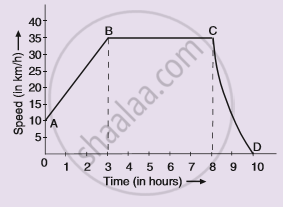
(i) What is the initial speed of the car ?
(ii) What is the maximum speed attained by the car ?
(iii) Which part of the graph shows zero acceleration ?
(iv) Which part of the graph shows varying retardation ?
(v) Find the distance travelled in first 8 hours.
Which of the following statement is correct regarding velocity and speed of a moving body?
From the displacement-time graph of a cyclist given below in the Figure, find The average velocity in the first 4 s.
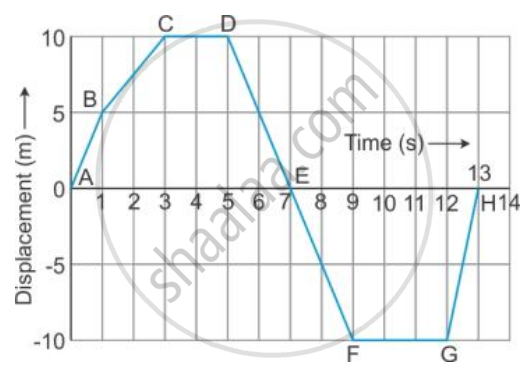
A speeding car changes its velocity from 108 kmh−1 to 36 kmh−1 in 4 s. Calculate its deceleration in
- ms−2
- kmh−2.
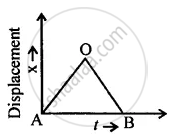
Write down the type of motion of a body along with the A – O – B of the following distance – time graph.