Advertisements
Advertisements
प्रश्न
The graph given alongside shows how the speed of a car changes with time:
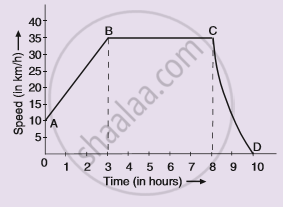
(i) What is the initial speed of the car ?
(ii) What is the maximum speed attained by the car ?
(iii) Which part of the graph shows zero acceleration ?
(iv) Which part of the graph shows varying retardation ?
(v) Find the distance travelled in first 8 hours.
Advertisements
उत्तर
(i) Initial speed of the car is 10 km/h
(ii) Maximum speed attained by the car is 35km/h
(iii) BC represents zero acceleration.
(iv) CD represents varying retardation.
(v) Distance travelled is given by the area enclosed within the curve. So,
Distance travelled = Area or trapezium + Area of rectangle
So distance travelled,
= (1/2)(8+5)(25) + (8)(10)
= 242.5 km
APPEARS IN
संबंधित प्रश्न
Write the formula for acceleration. Give the meaning of each symbol which occurs in it.
A motorcyclist drives from place A to B with a uniform speed of 30 km h-1 and returns from place B to A with a uniform speed of 20 km h-1. Find his average speed.
A car is moving along a straight road at a steady speed. It travels 150 m in 5 seconds:
How long does it take to travel 240 m ?
The tip of seconds’ hand of a dock takes 60 seconds to move once on the circular dial of the clock. If the radius of the dial of the clock be 10.5 cm, calculate the speed of the tip of the seconds’ hand of the clock. `("Given" π= 22/7)`.
What do you mean by motion in one direction?
Express the following in m s-1.
18 km min-1
Figure shows the displacement of a body at different times .
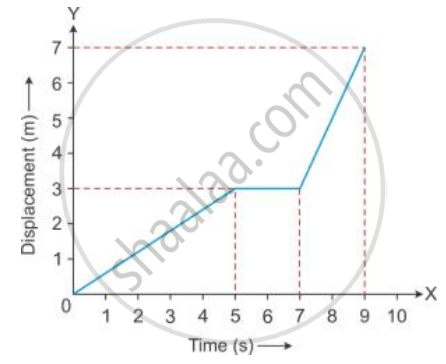
Calculate the average velocity during the time interval 5 s to 9 s ,
[Hint : From 5 s to 9 s , displacement = 7 m - 3m = 4m]
A train is moving with a velocity of 90 km h-1 . It is brought to stop by applying the brakes which produce a retardation of 0.5 ms-2 Find :
(i) The velocity after 10 s , and
(ii) the time taken by the train to come to rest .
What is the relation between distance and time when the body is moving with uniform velocity?
What are the uses of equations of motion?
