Advertisements
Advertisements
Question
The graph given alongside shows how the speed of a car changes with time:
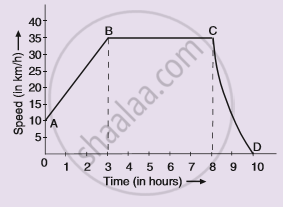
(i) What is the initial speed of the car ?
(ii) What is the maximum speed attained by the car ?
(iii) Which part of the graph shows zero acceleration ?
(iv) Which part of the graph shows varying retardation ?
(v) Find the distance travelled in first 8 hours.
Advertisements
Solution
(i) Initial speed of the car is 10 km/h
(ii) Maximum speed attained by the car is 35km/h
(iii) BC represents zero acceleration.
(iv) CD represents varying retardation.
(v) Distance travelled is given by the area enclosed within the curve. So,
Distance travelled = Area or trapezium + Area of rectangle
So distance travelled,
= (1/2)(8+5)(25) + (8)(10)
= 242.5 km
APPEARS IN
RELATED QUESTIONS
Abdul, while driving to school, computes the average speed for his trip to be 20 km h−1. On his return trip along the same route, there is less traffic and the average speed is 30 km h−1. What is the average speed for Abdul’s trip?
Arrange the following speed in increasing order (keeping the least speed first):
An athlete running with a speed of 10 m/s.
Write the formula for acceleration. Give the meaning of each symbol which occurs in it.
If a bus travelling at 20 m/s is subjected to a steady deceleration of 5 m/s2, how long will it take to come to rest ?
A car is moving along a straight road at a steady speed. It travels 150 m in 5 seconds:
What is its average speed ?
A car is moving along a straight road at a steady speed. It travels 150 m in 5 seconds:
How far does it travel in 6 seconds ?
What is the relation between distance and time when the body is moving with uniform velocity?
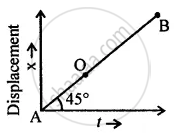
Write down the type of motion of a body along with the A – O – B of the following distance – time graph.
How many variables are present in each equation of motion?
Derive th e equation of motion.
S = ut+ `1/2` at2,
Where the symbols have their usual meanings
