Advertisements
Advertisements
Question
Which of the following can sometimes be 'zero' for a moving body?
(i) average velocity
(ii) distance travelled
(iii) average speed
(iv) displacement
Options
only (i)
(i) and (ii)
(i) and (iv)
only (iv)
Advertisements
Solution
(i) and (iv)
Distance is the length of the actual path covered by a moving body. This implies that the distance travelled by a moving body and also its average speed can never be zero at any point of time. However, it is possible for the displacement as well as average velocity for the body to be zero at an instance during the motion of the particle.
APPEARS IN
RELATED QUESTIONS
Arrange the following speed in increasing order (keeping the least speed first):
A bicycle moving with a speed of 200 m/min.
A car is moving along a straight road at a steady speed. It travels 150 m in 5 seconds:
How far does it travel in 1 second ?
Express the following in m s-1.
18 km min-1
The velocity-time graph of a moving body is given below in Figure
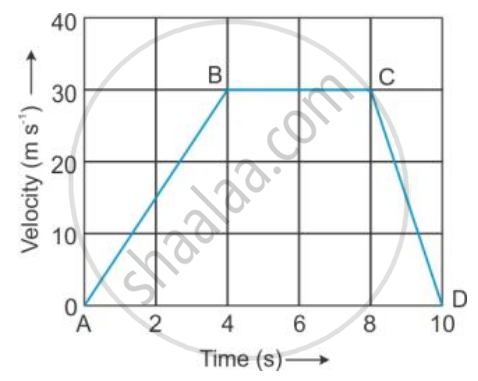
Total displacement.
The velocity-time graph of a moving body is given below in Figure
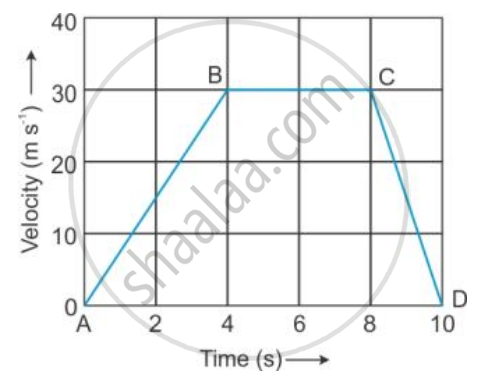
Displacement in each part AB, BC and CD.
A body moves from rest with uniform acceleration and travels 270 m in 3 s. Find the velocity of the body at 10 s after the start.
Define average velocity and give one example.
Draw a diagram to show the motion of a body whose speed remains constant, but velocity changes continuously.
A body projected vertically up with a velocity of 10 m/s reaches a height of 20 m. If it is projected with a velocity of 20 m/s, then the maximum height reached by the body is:
