Advertisements
Advertisements
प्रश्न
Which of the following can sometimes be 'zero' for a moving body?
(i) average velocity
(ii) distance travelled
(iii) average speed
(iv) displacement
पर्याय
only (i)
(i) and (ii)
(i) and (iv)
only (iv)
Advertisements
उत्तर
(i) and (iv)
Distance is the length of the actual path covered by a moving body. This implies that the distance travelled by a moving body and also its average speed can never be zero at any point of time. However, it is possible for the displacement as well as average velocity for the body to be zero at an instance during the motion of the particle.
APPEARS IN
संबंधित प्रश्न
What do the following measure in a car ?
(a) Speedometer (b) Odometer
Fill in the following blank with suitable word:
The physical quantity which gives both, the speed and direction of motion of a body is called its……………
Write the formula for acceleration. Give the meaning of each symbol which occurs in it.
A car is moving along a straight road at a steady speed. It travels 150 m in 5 seconds:
How long does it take to travel 240 m ?
A ball hits a wall horizontally at 6.0 m s-1. It rebounds horizontally at 4.4 m s-1. The ball is in contact with the wall for 0.040 s. What is the acceleration of the ball ?
Which of the following could not be a unit of speed?
Express the following in m s-1.
18 km min-1
The velocity-time graph of a moving body is given below in Figure
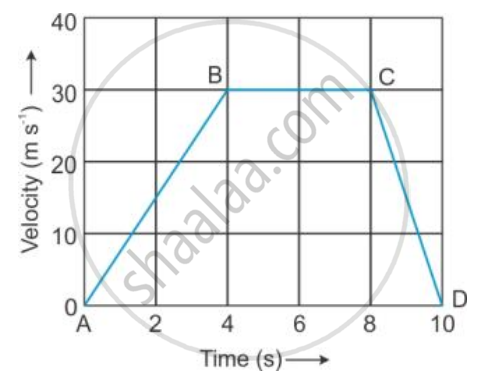
The acceleration in parts AB, BC and CD.
Define speed of a body.
A motorcyclist drives from A to B with a uniform speed of 30 km h–1 and returns back with a speed of 20 km h–1. Find its average speed.
