Advertisements
Advertisements
प्रश्न
When a car driver travelling at a speed of 10 m/s applies brakes and brings the car to rest in 20 s, then retardation will be :
पर्याय
+ 2 m/s2
− 2 m/s2
− 0.5 m/s2
+ 0.5 m/s2
Advertisements
उत्तर
+ 0.5 m/s2
The term “retardation” means negative acceleration.
Initial velocity = 10 m/s
Final velocity = 0 m/s
Time taken = 20 s
Acceleration = `"0-10"/20`
⇒ Acceleration = `-0.5 "m/s"^2`
⇒ Retardation = 0.5 `"m/s"^2`
APPEARS IN
संबंधित प्रश्न
Give one example of a situation in which a body has a certain average speed but its average velocity is zero.
Fill in the following blank with suitable word :
Velocity is the rate of change of……………………… It is measured in.............. .
What term is used to denote the change of velocity with time ?
A train travelling at 20 m s-1 accelerates at 0.5 m s-2 for 30 s. How far will it travel in this time ?
Which of the following could not be a unit of acceleration?
State how the velocity-time graph can be used to find
The acceleration of a body
Write three equations of uniformly accelerated motion relating the initial velocity (u), final velocity (v), time (t), acceleration (a) and displacement (S).
Can you suggest a real-life example about the motion of a body from the following velocity – time graph?
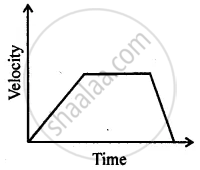
Can you suggest a real-life example about the motion of a body from the following velocity – time graph?
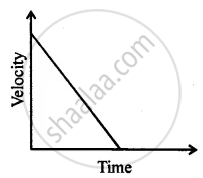
Draw a velocity versus time graph of a stone thrown vertically upwards and then coming downwards after attaining the maximum height.
