Advertisements
Advertisements
प्रश्न
A stone thrown vertically upwards takes 3 s to attain maximum height. Calculate
- initial velocity of the stone
- maximum height attained by the stone. (Take g = 9.8 ms−2)
Advertisements
उत्तर
Initial velocity of the stone = u =?
At highest point, final velocity = v = 0
Time = t = 3s
Acceleration = a = −g = −9.8 ms−2
Maximum height attained by stone = S = h = ?
(i) v = u + at
0 = u + (−9.8) 3
u = 9.8 × 3 = 29.4 ms−1
(ii) Now, S = ut + `1/2` at2
h = `(29.4)3+1/2(-9.8)(3)^2` = 88.2 − 4.9 × 9
= 88.2 − 44.1 = 44.1 m
APPEARS IN
संबंधित प्रश्न
Fill in the following blank with suitable word :
A motorcycle has a steady……………. of 3 m/s2. This means that every………………. its…………….. increases by………….
Fill in the following blank with a suitable word:
Acceleration is the rate of change of ______ It is measured in ______
What is meant by the term acceleration ? State the SI unit of acceleration.
Find the initial velocity of a car which is stopped in 10 seconds by applying brakes. The retardation due to brakes is 2.5 m/s2.
A train travelling at 20 m s-1 accelerates at 0.5 m s-2 for 30 s. How far will it travel in this time ?
The velocity-time graph of a body in motion is a straight line inclined to the time axis. The correct statement is ___________
Multiple choice Question. Select the correct option.
At the maximum height, a body thrown vertically upwards has :
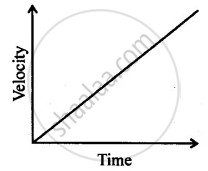
Can you suggest a real-life example about the motion of a body from the following velocity – time graph?
A body is thrown vertically upward with velocity u, the greatest height h to which it will rise is,
An electron moving with a velocity of 5 × 10⁴ ms−1 enters into a uniform electric field and acquires a uniform acceleration of 104 ms–2 in the direction of its initial motion.
(i) Calculate the time in which the electron would acquire a velocity double of its initial velocity.
(ii) How much distance the electron would cover at this time?
