Advertisements
Advertisements
प्रश्न
A body starts from rest and acquires a velocity 10 m s-1 in 2 s. Find the acceleration.
Advertisements
उत्तर
Here, final velocity = 10 m/s
Initial velocity = 0 m/s
Time taken = 2s
Acceleration = (Final Velocity - Initial Velocity)/time
= (10/2) ms-2
= 5 ms-2
APPEARS IN
संबंधित प्रश्न
Name the physical quantity whose SI unit is :
(a) m/s (b) m/s2
A bus running at a speed of 18 km/h is stopped in 2.5 seconds by applying brakes. Calculate the retardation produced.
A cheetah starts from, rest, and accelerates at 2 m/s2 for 10 seconds. Calculate :
(a) the final velocity
(b) the distance travelled.
When a car driver travelling at a speed of 10 m/s applies brakes and brings the car to rest in 20 s, then retardation will be :
Give one example of following motion :
Variable acceleration
The figure shows the displacement - time graph for four bodies A, B C and D. In each case state what information do you get about the acceleration (zero, positive or negative).
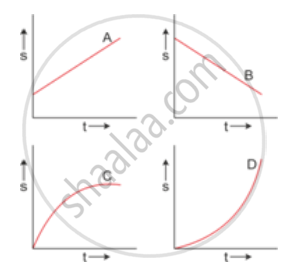
When is the positive acceleration?
The velocity-time graph (Fig. 8.5) shows the motion of a cyclist. Find (i) its acceleration (ii) its velocity and (iii) the distance covered by the cyclist in 15 seconds.

An electron moving with a velocity of 5 × 10⁴ ms−1 enters into a uniform electric field and acquires a uniform acceleration of 104 ms–2 in the direction of its initial motion.
(i) Calculate the time in which the electron would acquire a velocity double of its initial velocity.
(ii) How much distance the electron would cover at this time?
When will you say a body is at uniform acceleration?
