Advertisements
Advertisements
प्रश्न
A car moving on a straight path covers a distance of 1 km due east in 100 s. What is velocity of the car?
Advertisements
उत्तर
Distance = 1 km = 1000 m
Time = 100 s
Speed = `("distance")/("time")`
= `(1000)/(100)`
= 10 m/s
Velocity of car = Speed with direction = 10 m/s due east
APPEARS IN
संबंधित प्रश्न
A motorcyclist starts from rest and reaches a speed of 6 m/s after travelling with uniform acceleration for 3 s. What is his acceleration ?
A ball hits a wall horizontally at 6.0 m s-1. It rebounds horizontally at 4.4 m s-1. The ball is in contact with the wall for 0.040 s. What is the acceleration of the ball ?
A train starting from rest moves with a uniform acceleration of 0.2 m/s2 for 5 minutes. Calculate the speed acquired and the distance travelled in this time.
The tip of seconds’ hand of a dock takes 60 seconds to move once on the circular dial of the clock. If the radius of the dial of the clock be 10.5 cm, calculate the speed of the tip of the seconds’ hand of the clock. `("Given" π= 22/7)`.
A bus moving along a straight line at 20 m/s undergoes an acceleration of 4 m/s2. After 2 seconds, its speed will be:
Give an example of the motion of a body moving with a constant speed but with a variable velocity. Draw a diagram to represent such a motion.
Give one example of following motion :
Variable velocity
Figure shows the displacement of a body at different times .
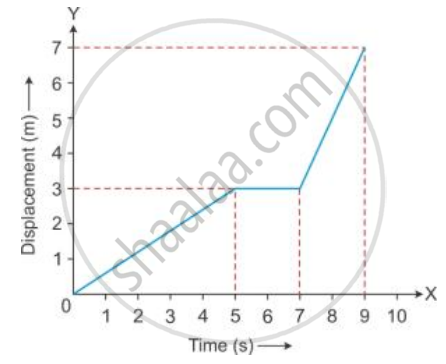
Calculate the average velocity during the time interval 5 s to 9 s ,
[Hint : From 5 s to 9 s , displacement = 7 m - 3m = 4m]
The velocity-time graph of a moving body is given below in Figure
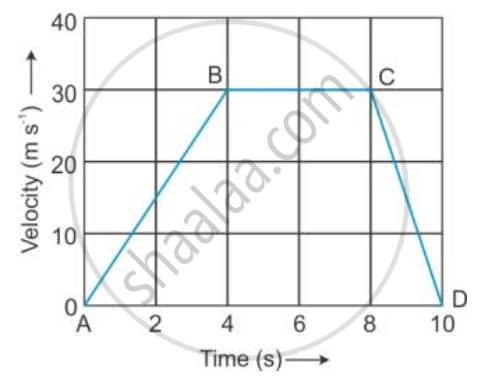
Displacement in each part AB, BC and CD.
Define average velocity and give one example.
