Advertisements
Advertisements
प्रश्न
A packet is dropped from a stationary helicopter, hovering at a height ‘h’ from ground level, reaches the ground in 12s. Calculate
- the value of h
- final velocity of packet on reaching the ground. (Take g = 9.8 ms−2)
Advertisements
उत्तर
Height of the helicopter = h =?
Initial velocity = u = 0
Time = t = 12s
Acceleration = a = + g = + 9.8 ms−2
(1) S = ut + `1/2` at2
h = `0(12)+1/2(9.8)(12)^2`
h = 0 + 4.9 (144)
h = 705.6 m
(2) Let v = velocity of the packet on reaching the ground.
v = u + at
v = 0 + (9.8) 12
v = 117.6 ms−1
APPEARS IN
संबंधित प्रश्न
A bus decreases its speed from 80 km h−1 to 60 km h−1 in 5 s. Find the acceleration of the bus.
A train starting from a railway station and moving with uniform acceleration attains a speed 40 km h−1 in 10 minutes. Find its acceleration.
Name the quantity which is measured by the area occupied under the velocity-time graph.
Find the initial velocity of a car which is stopped in 10 seconds by applying brakes. The retardation due to brakes is 2.5 m/s2.
Explain the meaning of the following equation of motion :v = u + at, where symbols have their usual meanings.
Derive the formula s= `ut+1/2at^2` , where the symbols have usual meanings.
A freely falling object travels 4.9 m in 1st second, 14.7 m in 2 nd second, 24.5 m in 3rd second, and so on. This data shows that the motion of a freely falling object is a case of :
The figure shows the displacement - time graph for four bodies A, B C and D. In each case state what information do you get about the acceleration (zero, positive or negative).
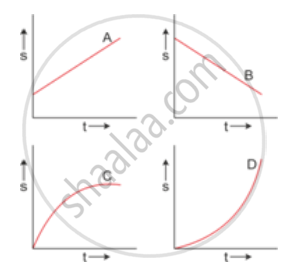
When is the positive acceleration?
Multiple choice Question. Select the correct option.
The speed of a car reduces from 15 m/s to 5 m/s over a displacement of 10 m. The uniform acceleration of the car is :
