Advertisements
Advertisements
Question
When a car driver travelling at a speed of 10 m/s applies brakes and brings the car to rest in 20 s, then retardation will be :
Options
+ 2 m/s2
− 2 m/s2
− 0.5 m/s2
+ 0.5 m/s2
Advertisements
Solution
+ 0.5 m/s2
The term “retardation” means negative acceleration.
Initial velocity = 10 m/s
Final velocity = 0 m/s
Time taken = 20 s
Acceleration = `"0-10"/20`
⇒ Acceleration = `-0.5 "m/s"^2`
⇒ Retardation = 0.5 `"m/s"^2`
APPEARS IN
RELATED QUESTIONS
Define velocity. What is the SI unit of velocity ?
Explain the meaning of the following equation of motion :v = u + at, where symbols have their usual meanings.
A train starting from stationary position and moving with uniform acceleration attains a speed of 36 km per hour in 10 minutes. Find its acceleration.
When is the negative acceleration?
Multiple choice Question. Select the correct option.
A body dropped from the top of a tower reaches the ground in 4s. Height of the tower is
Multiple choice Question. Select the correct option.
The speed of a car reduces from 15 m/s to 5 m/s over a displacement of 10 m. The uniform acceleration of the car is :
How can you find the following?
Acceleration from velocity – time graph.
Can you suggest a real-life example about the motion of a body from the following velocity – time graph?
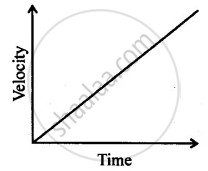
Area under a v – t graph represents a physical quantity which has the unit
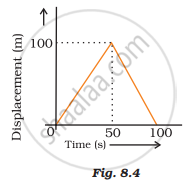
A girl walks along a straight path to drop a letter in the letterbox and comes back to her initial position. Her displacement–time graph is shown in Fig.8.4. Plot a velocity-time graph for the same.