Advertisements
Advertisements
Question
A car is travelling along the road at 8 ms-1. It accelerates at 1 ms-2 for a distance of 18 m. How fast is it then travelling ?
Advertisements
Solution
We have to find the final velocity of the moving object. And we have the following information
Initial velocity, (u) = 8 m/s
Acceleration, (a) = 1 m/s2
Distance, (s) = 18 m
So applying 3rd equation of motion to calculate the final velocity,
`ν = sqrt(u^2 + 2as)`
Where,
(a) - Acceleration
(ν) - Final velocity
(u) - Initial velocity
(s) - Distance
Put the values in the above equation to get the value of final velocity,
`ν = sqrt(64 + 36)` m/s
= `sqrt(100)` m/s
= 10 m/s
APPEARS IN
RELATED QUESTIONS
Fill in the following blank with a suitable word:
Acceleration is the rate of change of ______ It is measured in ______
What term is used to denote the change of velocity with time ?
Explain the meaning of the following equation of motion :v = u + at, where symbols have their usual meanings.
A body starting from rest travels with uniform acceleration. If it travels 100 m in 5 s, what is the value of acceleration ?
Derive the formula : v = u + at, where the symbols have usual meanings.
A car acquire a velocity of 72 km per hour in 10 second starting from rest. Find
(1) the acceleration,
(2) the average velocity, and
(3) the distance travelled in this time.
Multiple choice Question. Select the correct option.
A body dropped from the top of a tower reaches the ground in 4s. Height of the tower is
Multiple choice Question. Select the correct option.
At the maximum height, a body thrown vertically upwards has :
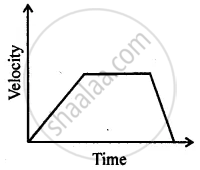
Can you suggest a real-life example about the motion of a body from the following velocity – time graph?
Area under a v – t graph represents a physical quantity which has the unit
