Advertisements
Advertisements
Question
A car is travelling at 20 m/s along a road. A child runs out into the road 50 m ahead and the car driver steps on the brake pedal. What must the car’s deceleration be if the car is to stop just before it reaches the child ?
Advertisements
Solution
We have to find the deceleration. We have the following information given,
Initial velocity, (u) = 20 m/s
Final velocity, (v) = 0 m/s
Distance travelled, (s) = 50 m
Let the deceleration for the entire journey be (a)
We can calculate acceleration by using the 3rd equation of motion,
`a = (v^2-u^2)/(2s)`
(s) - Displacement
(u) - Initial velocity
(a) - Acceleration
(v) - Final velocity
Put the values in above equation to find the deceleration,
`a = [(0-400)/(2(50)]] "m/s"^2`
= `(-400/100)` `"m/s"^2`
= -4 `"m/s"^2`
Hence, deceleration is 4 m/s2.
APPEARS IN
RELATED QUESTIONS
Show the shape of the distance-time graph for the motion in the following case:
A car moving with a constant speed.
Figure shows the distance-time graph for the motion of two vehicles A and B. Which one of them is moving faster?
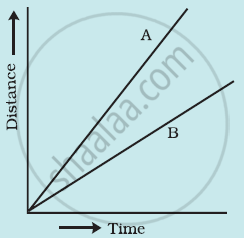
Figure: Distance-time graph for the motion of two cars
What does the slope of a distance-time graph indicate ?
Fill in the following blank with suitable word :
The slope of a speed-time graph of a moving body gives its………………………..
Name the two quantities, the slope of whose graph give speed .
A student draws a distance-time graph for a moving scooter and finds that a section of the graph is horizontal line parallel to the time axis. Which of the following conclusion is correct about this section of the graph?
A body moves along a straight road with a speed of 20 m/s and has a uniform acceleration of 5 m/s2. What will be its speed after 2 s?
If we denote speed by S, distance by D and time by T, the relationship between these quantities is ______.
Distance between Bholu’s and Golu’s house is 9 km. Bholu has to attend Golu’s birthday party at 7 o’clock. He started from his home at 6 o’clock on his bicycle and covered a distance of 6 km in 40 minutes. At that point, he met Chintu and he spoke to him for 5 minutes and reached Golu’s birthday party at 7 o’clock. With what speed did he cover the second part of the journey? Calculate his average speed for the entire journey.
The area under velocity time graph represents ______.
