Advertisements
Advertisements
प्रश्न
A car is travelling at 20 m/s along a road. A child runs out into the road 50 m ahead and the car driver steps on the brake pedal. What must the car’s deceleration be if the car is to stop just before it reaches the child ?
Advertisements
उत्तर
We have to find the deceleration. We have the following information given,
Initial velocity, (u) = 20 m/s
Final velocity, (v) = 0 m/s
Distance travelled, (s) = 50 m
Let the deceleration for the entire journey be (a)
We can calculate acceleration by using the 3rd equation of motion,
`a = (v^2-u^2)/(2s)`
(s) - Displacement
(u) - Initial velocity
(a) - Acceleration
(v) - Final velocity
Put the values in above equation to find the deceleration,
`a = [(0-400)/(2(50)]] "m/s"^2`
= `(-400/100)` `"m/s"^2`
= -4 `"m/s"^2`
Hence, deceleration is 4 m/s2.
APPEARS IN
संबंधित प्रश्न
The speed-time graph for a car is shown in the following figure:
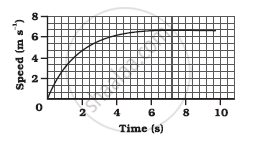
- Find how far the car travels in the first 4 seconds. Shade the area on the graph that represents the distance travelled by the car during the period.
- Which part of the graph represents uniform motion of the car?
Show the shape of the distance-time graph for the motion in the following case:
A car moving with a constant speed.
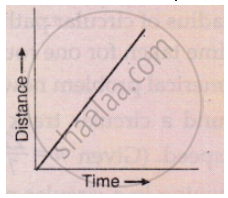
What conclusion can you draw about the speed of a body from the following distance-time graph ?
Fill in the following blank with suitable word :
The slope of a speed-time graph of a moving body gives its………………………..
A cyclist is travelling at 15 m s-1. She applies brakes so that she does not collide with a wall 18 m away. What deceleration must she have ?
A student draws a distance-time graph for a moving scooter and finds that a section of the graph is horizontal line parallel to the time axis. Which of the following conclusion is correct about this section of the graph?
Two friends leave Delhi for Chandigarh in their cars. A starts at 5 am and moves with a constant speed of 30 km/h, whereas B starts at 6 am and moves with a constant speed of 40 kmh-1. Plot the distance-time graph for their motion and find at what time the two friends will meet and at what distance from Delhi.
What are the uses of the graphical study of motion?
Complete the data of the table given below with the help of the distance-time graph given in the figure.
| Distance (m) | 0 | 4 | ? | 12 | ? | 20 |
| Time (s) | 0 | 2 | 4 | ? | 8 | 10 |

The slope of the distance-time curve is steeper/greater is the ______.
