Advertisements
Advertisements
प्रश्न
What can you say about the motion of an object whose distance-time graph is a straight line parallel to the time axis?
Advertisements
उत्तर
When an object is at rest, its distance-time graph is a straight line parallel to the time axis.
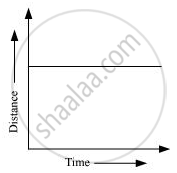
A straight line parallel to the x-axis in a distance-time graph indicates that with a change in time, there is no change in the position of the object. Thus, the object is at rest.
संबंधित प्रश्न
What is the nature of the distance-time graphs for uniform and non-uniform motion of an object?
What can you say about the motion of an object if its speed-time graph is a straight line parallel to the time axis?
A driver of a car travelling at 52 km h−1 applies the brakes and accelerates uniformly in the opposite direction. The car stops in 5 s. Another driver going at 3 km h−1 in another car applies his brakes slowly and stops in 10 s. On the same graph paper, plot the speed versus time graphs for the two cars. Which of the two cars travelled farther after the brakes were applied?
Which of the following distance-time graphs shows a truck moving with speed which is not constant?
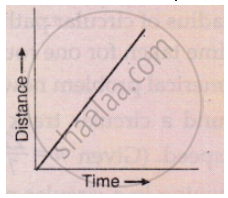
What conclusion can you draw about the speed of a body from the following distance-time graph ?
A cyclist is travelling at 15 m s-1. She applies brakes so that she does not collide with a wall 18 m away. What deceleration must she have ?
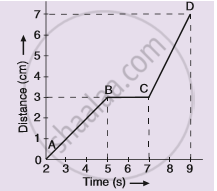
The graph given alongside shows the positions of a body at different times. Calculate the speed of the body as it moves from :
(1) A to B,
(2) B to C, and
(3) C to D.
A spaceship is moving in space with a velocity of 60 kms−1. It fires its retro engines for 20 seconds and velocity is reduced to 55 kms−1. Calculate the distance travelled by a spaceship in 40 s, from the time of firing of the retro- rockets.
If we denote speed by S, distance by D and time by T, the relationship between these quantities is ______.
The area under velocity time graph represents ______.
