Advertisements
Advertisements
Question
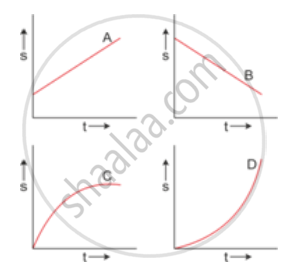
The figure shows the displacement - time graph for four bodies A, B C and D. In each case state what information do you get about the acceleration (zero, positive or negative).
Advertisements
Solution
For body A: The graph is a straight line. So, the slope gives constant velocity. Hence, the acceleration for body A is zero.
For body B: The graph is a straight line. So, the slope gives constant velocity. Hence, the acceleration for body B is also zero.
For body C: The slope of the graph is decreasing with time. Hence, the acceleration is negative.
For body D: The slope of the graph is increasing with time. Hence, the acceleration is positive.
APPEARS IN
RELATED QUESTIONS
Which of the two can be zero under certain conditions : average speed of a moving body or average velocity of a moving body ?
Define velocity. What is the SI unit of velocity ?
A bus running at a speed of 18 km/h is stopped in 2.5 seconds by applying brakes. Calculate the retardation produced.
A boy is sitting on a merry-go-round which is moving with a constant speed of 10 m s−1. This means that the boy is :
A bus increases its speed from 36 km/h to 72 km/h in 10 seconds. Its acceleration is :
Derive the following equations for uniformly accelerated motion:
(i) v = u + at
(ii) `"S = ut" + 1/2 "at"^2`
(iii) v2 = u2 + 2aS
where the symbols have their usual meanings.
A body, initially at rest, starts moving with a constant acceleration 2 m s-2. Calculate: (i) the velocity acquired and (ii) the distance travelled in 5 s.
What do you understand by the term acceleration?
When is the negative acceleration?
How will the equations of motion for an object moving with a uniform velocity change?
