Advertisements
Advertisements
Question
A car acquire a velocity of 72 km per hour in 10 second starting from rest. Find
(1) the acceleration,
(2) the average velocity, and
(3) the distance travelled in this time.
Advertisements
Solution
We have the following information,
Initial velocity, (u) = 0 m/s
Final velocity
`(v)` = 72 km/hr
= `"72(1000)"/3600` m/s
= 20 m/s
Time taken , (t) = (10) s
(i) So acceleration,
`a = (v-u)/t`
Put the values in the above equation to get the value of acceleration
`a = (20-0)/10`
= 2 `"m/s"^2`
(ii) we have to find the average velocity. we will use the following relation,
Average velocity = `"Initial velocity + Final velocity"/2`
So , Average velocity = `(v+u)/2`
Therefore putting the value in the above to get the avearge velocity ,
Average velocity = `(20+0)/2` m/s
= 10 m/s
(iii) We have to calculate the distance travelled. We will use the relation,
Distance travelled = (Average velocity) (Time)
So distance travelled is,
= (10)(10) m
= 100 m
APPEARS IN
RELATED QUESTIONS
What is meant by the term acceleration ? State the SI unit of acceleration.
Explain why, the motion of a body which is moving with constant speed in a circular path is said to be accelerated.
A body starting from rest travels with uniform acceleration. If it travels 100 m in 5 s, what is the value of acceleration ?
A bus was moving with a speed of 54 km/h. On applying brakes it stopped in 8 seconds. Calculate the acceleration.
Derive the formula s= `ut+1/2at^2` , where the symbols have usual meanings.
A bus increases its speed from 36 km/h to 72 km/h in 10 seconds. Its acceleration is :
The velocity-time graph of a body in motion is a straight line inclined to the time axis. The correct statement is ___________
Multiple choice Question. Select the correct option.
The speed of a car reduces from 15 m/s to 5 m/s over a displacement of 10 m. The uniform acceleration of the car is :
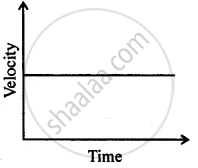
Can you suggest a real-life example about the motion of a body from the following velocity – time graph?
A body is thrown vertically upward with velocity u, the greatest height h to which it will rise is,
