Advertisements
Advertisements
Question
A body is thrown vertically upward with velocity u, the greatest height h to which it will rise is,
Options
`"u"/"g"`
`"u"^2/(2"g")`
`"u"^2/"g"`
`"u"/(2"g")`
Advertisements
Solution
`"u"^2/(2"g")`
At highest point, v = 0
Using v2– u2 = 2as, we get
0 − u2 = 2(−g)h ( ∵ a = −g and s = h)
or h = `"u"^2/(2"g")`
APPEARS IN
RELATED QUESTIONS
A body starting from rest travels with uniform acceleration. If it travels 100 m in 5 s, what is the value of acceleration ?
Derive the formula s= `ut+1/2at^2` , where the symbols have usual meanings.
A car acquire a velocity of 72 km per hour in 10 second starting from rest. Find
(1) the acceleration,
(2) the average velocity, and
(3) the distance travelled in this time.
A freely falling object travels 4.9 m in 1st second, 14.7 m in 2 nd second, 24.5 m in 3rd second, and so on. This data shows that the motion of a freely falling object is a case of :
The slope of a speed-time graph gives:
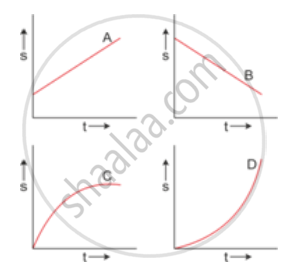
The figure shows the displacement - time graph for four bodies A, B C and D. In each case state what information do you get about the acceleration (zero, positive or negative).
For a uniformly retarded motion, the velocity-time graph is _____________
Can you suggest a real-life example about the motion of a body from the following velocity – time graph?
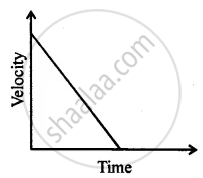
Draw a velocity versus time graph of a stone thrown vertically upwards and then coming downwards after attaining the maximum height.
An object starting from rest travels 20 m in the first 2 s and 160 m in the next 4 s. What will be the velocity after 7 s from the start?
