Advertisements
Advertisements
Question
The slope of a speed-time graph gives:
Options
distance travelled
velocity
acceleration
displacement
Advertisements
Solution
acceleration
The rate of change of speed per unit time is termed as acceleration. So, the answer is
(c) Acceleration
APPEARS IN
RELATED QUESTIONS
Fill in the following blank with suitable word :
A motorcycle has a steady……………. of 3 m/s2. This means that every………………. its…………….. increases by………….
Name the quantity which is measured by the area occupied under the velocity-time graph.
Explain why, the motion of a body which is moving with constant speed in a circular path is said to be accelerated.
A motorcycle moving with a speed of 5 m/s is subjected to an acceleration of 0.2 m/s2. Calculate the speed of the motorcycle after 10 seconds, and the distance travelled in this time.
A bicycle initially moving with a velocity 5.0 m s-1 accelerates for 5 s at a rate of 2 m s-2. What will be its final velocity?
Multiple choice Question. Select the correct option.
At the maximum height, a body thrown vertically upwards has :
How can you find the following?
Acceleration from velocity – time graph.
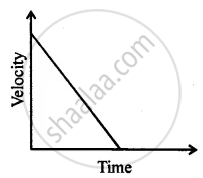
Can you suggest a real-life example about the motion of a body from the following velocity – time graph?
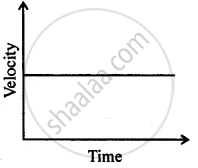
Can you suggest a real-life example about the motion of a body from the following velocity – time graph?
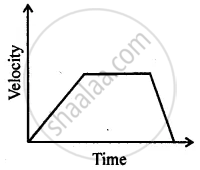
Can you suggest a real-life example about the motion of a body from the following velocity – time graph?