Advertisements
Advertisements
Question
A bicycle initially moving with a velocity 5.0 m s-1 accelerates for 5 s at a rate of 2 m s-2. What will be its final velocity?
Advertisements
Solution
Initial velocity of the bicycle, u = 5 m/s
Acceleration = 2 m/s2
Given time, t = 5 s
Let 'v' be the final velocity.
We know that, acceleration = Rate of change of velocity/time
= (Final velocity - Initial velocity)/time
Or 2 = (v - 5)/5
Or, 10 = (v - 5)
Or, v = 5 + 10
Or, v = 15 m/s
APPEARS IN
RELATED QUESTIONS
A bus decreases its speed from 80 km h−1 to 60 km h−1 in 5 s. Find the acceleration of the bus.
Fill in the following blank with suitable word :
A motorcycle has a steady……………. of 3 m/s2. This means that every………………. its…………….. increases by………….
Define velocity. What is the SI unit of velocity ?
A car acquire a velocity of 72 km per hour in 10 second starting from rest. Find
(1) the acceleration,
(2) the average velocity, and
(3) the distance travelled in this time.
A freely falling object travels 4.9 m in 1st second, 14.7 m in 2 nd second, 24.5 m in 3rd second, and so on. This data shows that the motion of a freely falling object is a case of :
When a car driver travelling at a speed of 10 m/s applies brakes and brings the car to rest in 20 s, then retardation will be :
Define velocity. State its unit.
If a stone and a pencil are dropped simultaneously in vacuum from the top of a tower, then which of the two will reach the ground first? Give reason.
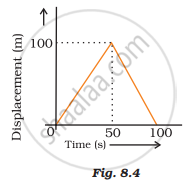
A girl walks along a straight path to drop a letter in the letterbox and comes back to her initial position. Her displacement–time graph is shown in Fig.8.4. Plot a velocity-time graph for the same.
Draw a velocity versus time graph of a stone thrown vertically upwards and then coming downwards after attaining the maximum height.
