Advertisements
Advertisements
Question
A body starting from rest travels with uniform acceleration. If it travels 100 m in 5 s, what is the value of acceleration ?
Advertisements
Solution
We have to find the acceleration of the body. We have the following information given, Initial velocity,
Let the acceleration be (a)
Time taken,(t) = 5 s
Distance travelled, (s) = 100 m
We can calculate the distance travelled by using the 2nd equation of motion,
`s = ut + 1/2at^2`
Put the values in above equation to find the acceleration of the body ,
`100 = 0(5) + 1/2(a)(5^2)`
On further simplification ,
`(25a)/2` = 100
therefore,
`a = 200/25`
= `8 "m/s"^2`
APPEARS IN
RELATED QUESTIONS
Define velocity. What is the SI unit of velocity ?
What is meant by the term acceleration ? State the SI unit of acceleration.
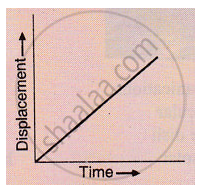
What conclusion can you draw about the velocity of a body from the displacement-time graph shown below :
A boy is sitting on a merry-go-round which is moving with a constant speed of 10 m s−1. This means that the boy is :
If a stone and a pencil are dropped simultaneously in vacuum from the top of a tower, then which of the two will reach the ground first? Give reason.
A body starts from rest and acquires a velocity 10 m s-1 in 2 s. Find the acceleration.
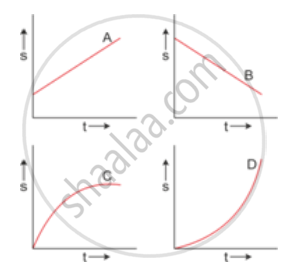
The figure shows the displacement - time graph for four bodies A, B C and D. In each case state what information do you get about the acceleration (zero, positive or negative).
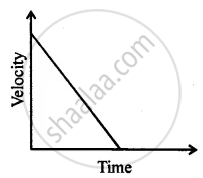
For a uniformly retarded motion, the velocity-time graph is _____________
Can you suggest a real-life example about the motion of a body from the following velocity – time graph?
Draw a velocity versus time graph of a stone thrown vertically upwards and then coming downwards after attaining the maximum height.
