Advertisements
Advertisements
प्रश्न
A body starting from rest travels with uniform acceleration. If it travels 100 m in 5 s, what is the value of acceleration ?
Advertisements
उत्तर
We have to find the acceleration of the body. We have the following information given, Initial velocity,
Let the acceleration be (a)
Time taken,(t) = 5 s
Distance travelled, (s) = 100 m
We can calculate the distance travelled by using the 2nd equation of motion,
`s = ut + 1/2at^2`
Put the values in above equation to find the acceleration of the body ,
`100 = 0(5) + 1/2(a)(5^2)`
On further simplification ,
`(25a)/2` = 100
therefore,
`a = 200/25`
= `8 "m/s"^2`
APPEARS IN
संबंधित प्रश्न
Fill in the following blank with a suitable word:
Acceleration is the rate of change of ______ It is measured in ______
Define velocity. What is the SI unit of velocity ?
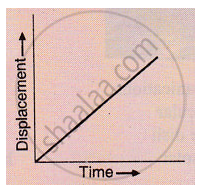
What conclusion can you draw about the velocity of a body from the displacement-time graph shown below :
Fill in the following blank with suitable word :
If a body moves with uniform velocity, its acceleration is ..............
Explain the meaning of the following equation of motion :v = u + at, where symbols have their usual meanings.
Give one example of following motion :
Variable acceleration
The velocity-time graph of a body in motion is a straight line inclined to the time axis. The correct statement is ___________
When is the positive acceleration?
When is the negative acceleration?
An object starting from rest travels 20 m in the first 2 s and 160 m in the next 4 s. What will be the velocity after 7 s from the start?
