Advertisements
Advertisements
Question
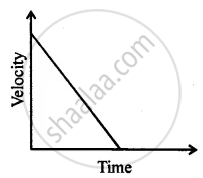
Can you suggest a real-life example about the motion of a body from the following velocity – time graph?
Advertisements
Solution
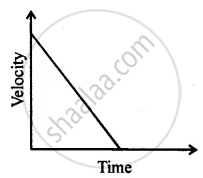
When you come home at activa from the market and stops in front of your home. Then the velocity of active decreases with time and its v – t graph will be the same as shown on the figure.
APPEARS IN
RELATED QUESTIONS
When will you say a body is at non-uniform acceleration?
Name the quantity which is measured by the area occupied under the velocity-time graph.
A train travelling at 20 m s-1 accelerates at 0.5 m s-2 for 30 s. How far will it travel in this time ?
A body starting from rest travels with uniform acceleration. If it travels 100 m in 5 s, what is the value of acceleration ?
A car acquire a velocity of 72 km per hour in 10 second starting from rest. Find
(1) the acceleration,
(2) the average velocity, and
(3) the distance travelled in this time.
A body starts from rest and acquires a velocity 10 m s-1 in 2 s. Find the acceleration.
Write three equations of uniformly accelerated motion relating the initial velocity (u), final velocity (v), time (t), acceleration (a) and displacement (S).
When is the positive acceleration?
How can you find the following?
Acceleration from velocity – time graph.
An object starting from rest travels 20 m in the first 2 s and 160 m in the next 4 s. What will be the velocity after 7 s from the start?
