Advertisements
Advertisements
Question
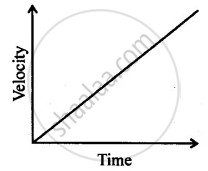
Can you suggest a real-life example about the motion of a body from the following velocity – time graph?
Advertisements
Solution

The figure shows that the car is moving with uniform acceleration. i.e. when velocity of car increases equally in equal intervals of time.
APPEARS IN
RELATED QUESTIONS
When will you say a body is at non-uniform acceleration?
Name the physical quantity whose SI unit is :
(a) m/s (b) m/s2
Explain the meaning of the following equation of motion :v = u + at, where symbols have their usual meanings.
A car acquire a velocity of 72 km per hour in 10 second starting from rest. Find
(1) the acceleration,
(2) the average velocity, and
(3) the distance travelled in this time.
Give one example of following motion :
Variable acceleration
The velocity-time graph of a body in motion is a straight line inclined to the time axis. The correct statement is ___________
How can you find the following?
Velocity from acceleration – time graph.
Can you suggest a real-life example about the motion of a body from the following velocity – time graph?
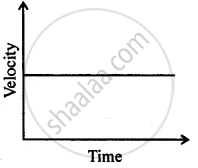
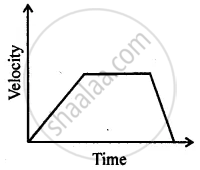
Can you suggest a real-life example about the motion of a body from the following velocity – time graph?
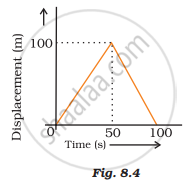
A girl walks along a straight path to drop a letter in the letterbox and comes back to her initial position. Her displacement–time graph is shown in Fig.8.4. Plot a velocity-time graph for the same.